


Running a successful business is exciting, but it also comes with responsibility. As your company grows, so do your assets, investments, and risks. Many business owners eventually reach a point where they need a smarter way to manage everything while protecting what they have built. That is where a holding company structure comes in.
If you have ever searched for what is a holding company or wondered holding company what is, you are asking the same question many entrepreneurs ask before expanding their businesses. A holding company can provide greater control, better asset protection, and a more flexible business structure. From ambitious startups to multinational corporations, businesses of every size use holding companies to support long-term growth.
At Brannon, we work with businesses across the UK, Malta, and international markets, helping them choose corporate structures that match their goals. Understanding how a holding company works is often the first step towards building a stronger and more resilient business.
What Is a Holding Company?
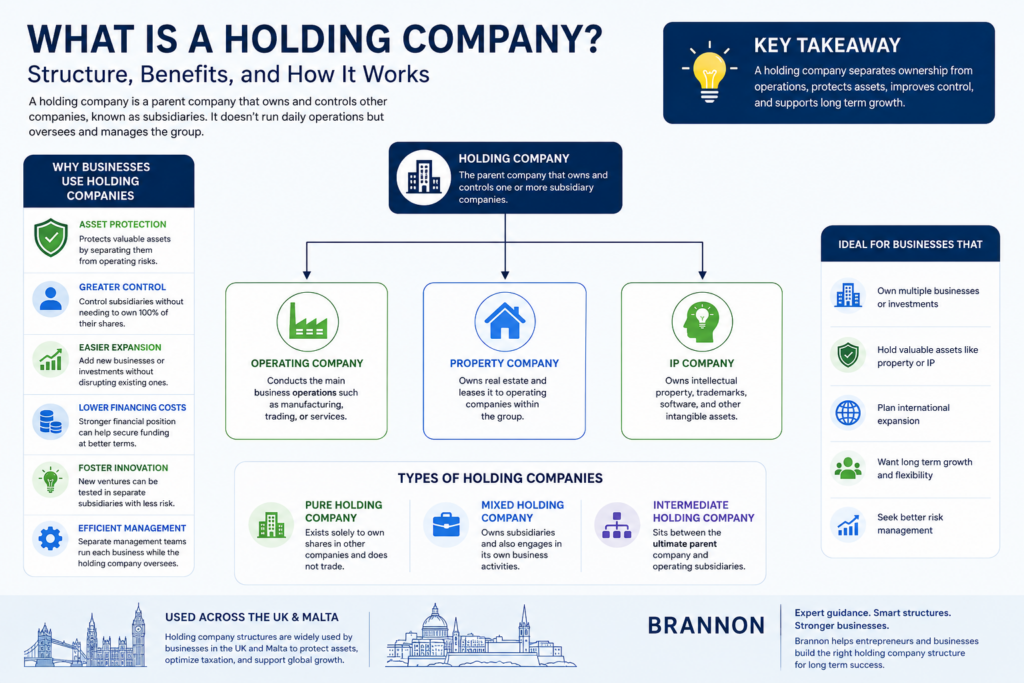
A holding company is a parent company that owns enough shares or ownership interests in one or more businesses to control them. These businesses are known as subsidiary companies.
Unlike traditional businesses, most holding companies do not manufacture products, sell goods, or provide services directly. Their primary role is to own, manage, and oversee other companies. Each subsidiary continues to run its own daily operations while the parent company focuses on strategic decisions and long-term planning.
Many people think only global corporations use this model, but that is no longer true. Today, businesses of every size are creating UK Holding structures to improve efficiency, reduce risk, and prepare for future growth.
How Does a Holding Company Structure Work?
A holding company structure separates ownership from day-to-day business activities. Instead of placing all assets and operations within a single business, responsibilities are divided among separate companies.
The parent company holds a controlling interest in one or more subsidiaries. Each subsidiary has its own management team and operates independently while remaining under the overall direction of the holding company.
For example, one subsidiary may provide consulting services. Another may own commercial property. A third could manage valuable trademarks, software, or intellectual property. Together, these businesses form the holdings of a company, creating a clear and organised corporate structure.
This approach allows businesses to grow without placing every investment under a single legal entity.
Types of Holding Companies
Not every holding company operates in the same way. Businesses choose different structures depending on their commercial objectives and investment strategy.
Pure Holding Company
A pure holding company exists solely to own shares in other companies. It does not trade, manufacture products, or provide services.
Its only purpose is to manage investments, oversee subsidiaries, and protect business assets.
Many investment groups and family-owned businesses choose this model because it creates a simple ownership structure while reducing operational risk.
Mixed Holding Company
A mixed holding company combines ownership with active business operations.
For example, the parent company may provide management services while also owning several operating businesses across different industries.
This model offers greater flexibility while allowing the parent company to generate its own income.
Intermediate Holding Company
Large organisations sometimes build several layers within their corporate structure.
An intermediate holding company sits between the ultimate parent company and operating subsidiaries. This arrangement helps simplify international ownership and improve management across different regions.
Why Are Holding Companies So Popular?
There is a reason why thousands of businesses around the world continue to adopt this structure.
A holding company offers far more than simple ownership. It creates opportunities for smarter financial planning, stronger governance, and better protection against business risks.
As companies expand into new industries or invest in additional businesses, separating ownership from operations becomes increasingly valuable.
That is why many successful holding firms use this structure as the foundation of their long-term business strategy.
The Biggest Benefits of a Holding Company
Business owners often choose a holding company because it provides several important advantages.
Better Protection for Valuable Assets
- Every business faces some level of risk.
- If all your assets are held within a single operating company, legal claims or financial problems could affect everything the business owns.
- A holding company structure reduces this risk by separating valuable assets from trading activities.
- For example, a property portfolio, intellectual property, machinery, or investment assets can be owned by separate subsidiaries rather than the trading business itself.
- If one subsidiary experiences financial difficulties, the assets of the other companies are generally protected.
- This level of separation is one of the main reasons holding companies remain popular in both the UK and Malta.
Greater Control Without Full Ownership
One of the most attractive features of a holding company is flexibility.
A parent company does not always need to own all the shares of a subsidiary. In many cases, owning a controlling interest is enough to influence important decisions and appoint company directors.
This allows a company owned by multiple investors to remain under the strategic direction of the parent company while reducing the amount of capital required for expansion.
For growing businesses, this can create new investment opportunities without taking on unnecessary financial pressure.
Easier Business Expansion
Growth often becomes more complicated as businesses diversify.
Imagine an entrepreneur who owns a successful technology company. A few years later, they purchase a logistics business and then invest in commercial property.
Rather than combining all investments into a single business, each venture can operate as a subsidiary of the same holding company.
This creates a cleaner structure, simplifies management, and makes future acquisitions much easier.
As new opportunities arise, additional subsidiaries can be added without disrupting the existing businesses.
For entrepreneurs planning long-term growth, this flexibility can become a significant competitive advantage.
Lower Financing Costs
A well-established holding company often has greater financial strength than a newly formed operating business. This can make it easier to secure funding on more favourable terms.
Instead of each subsidiary applying for finance independently, the parent company may obtain funding and allocate capital where it is needed most. This approach can support expansion while helping businesses manage cash flow more effectively.
For growing organisations, this flexibility can make a real difference when investing in new opportunities.
Holding Companies Are Not Just for Large Corporations
Many people assume only multinational businesses benefit from a holding company structure. In reality, small and medium-sized businesses can gain just as much value.
Imagine an entrepreneur who owns a successful marketing agency. After a few years, they invest in a commercial property and later acquire an e‑commerce business.
Instead of placing everything under one company, each investment becomes a separate subsidiary. The parent company oversees them all, while each business continues to operate independently.
This structure keeps finances organised, protects valuable assets, and makes future growth much easier to manage.
Across the UK and Malta, many family businesses and entrepreneurs are choosing this model because it supports long-term planning without adding unnecessary operational risk.
Real Business Example
Imagine Sarah owns a successful software company in London. As her business grows, she purchases an office building and launches a digital consultancy.
- Rather than placing all assets within the same business, Sarah forms a holding company.
- The software company becomes a subsidiary.
- The consultancy becomes another.
- A separate property company owns the office building.
- The holding company sits at the top and owns all three businesses.
If the consultancy experiences financial difficulties, the office building and software company are generally protected because they operate as separate legal entities.
This simple example shows why so many businesses choose a holding company structure when planning for future growth.
Are There Any Disadvantages?
Like every business structure, holding companies also come with responsibilities.
Understanding these challenges helps business owners make informed decisions before restructuring their organisations.
Additional Administration
Every company within the group has its own legal obligations.
Separate accounting records, annual filings, tax returns, and compliance requirements must all be maintained correctly.
While this adds administrative burden, many businesses consider the extra protection well worth the effort.
More Complex Management
Managing several companies naturally requires stronger organisation.
Each subsidiary should maintain its own contracts, bank accounts, employees, and financial records.
Maintaining clear boundaries between businesses helps preserve the legal protections that make the structure so valuable.
Professional Advice Is Important
Every business has different goals.
Tax considerations, legal obligations, shareholder arrangements, and international regulations all influence the best structure.
Working with experienced advisers helps ensure the holding company is designed to support future growth while remaining fully compliant.
How to Set Up a Holding Company
Creating a holding company starts with careful planning rather than simply registering another business.
Business owners should first define their long-term objectives.
- Do they want to protect assets?
- Are they planning future acquisitions?
- Will the business expand internationally?
Once these goals are clear, the next step is to establish the parent company and create one or more subsidiary businesses.
Several important decisions need to be made during the process.
Choose the Right Legal Structure
The legal entity should reflect the company’s ownership, investment plans, and future objectives.
Professional guidance can help determine the most suitable option.
Select the Best Jurisdiction
Many businesses compare jurisdictions before incorporating.
The UK and Malta remain popular choices because of their established legal systems, attractive business environments, and international reputation.
The right location depends on each company’s commercial activities and long-term strategy.
Build a Scalable Structure
A good holding company structure should support future growth.
Whether you plan to acquire additional businesses, purchase commercial property, or expand internationally, the structure should allow new subsidiaries to be added with minimal disruption.
Planning often saves significant time and costs later.
Common Mistakes Business Owners Should Avoid
Some businesses establish a holding company but fail to maintain proper separation between subsidiaries.
For example, using the same bank accounts, mixing financial records, or transferring assets without proper documentation can create legal complications.
Each company should operate independently, maintain accurate records, and clearly define responsibilities.
Maintaining this separation helps preserve liability protection and supports good corporate governance.
Frequently Asked Questions
Is a holding company legal in the UK?
Yes. Holding companies are widely used throughout the UK and are recognised as a legitimate way to own and manage subsidiary businesses.
Can one person own a holding company?
Yes. Many entrepreneurs establish a holding company that owns one or more subsidiary businesses.
Does a holding company trade?
Some do, while others do not.
A pure holding company usually exists only to own investments, while a mixed holding company may also carry out its own business activities.
Why do businesses create holding companies?
Businesses often create holding companies to protect valuable assets, improve management, simplify expansion, and separate different commercial activities.
Is a holding company suitable for small businesses?
Yes. Many small businesses benefit from this structure, especially when they own property, valuable intellectual property, or multiple business ventures.
Is a Holding Company the Right Choice?
There is no single structure that suits every business.
However, if your organisation owns valuable assets, plans to expand into new markets, or wants greater flexibility for future growth, a holding company may be worth considering.
Choosing the right structure early can help reduce risk, improve organisation, and create a stronger foundation for long-term success.
At Brannon, we help businesses across the UK, Malta, and international markets build corporate structures that support sustainable growth. Whether you are launching your first business, restructuring an existing organisation, or exploring a holding company for future investments, our experienced team can guide you through every stage with practical advice tailored to your goals.
Choosing a holding company structure requires more than selecting a parent entity. Founders should compare the operating jurisdiction, reporting duties, banking practicalities and where management actually takes place. Our UK company formation guide explains the current incorporation route and ongoing Companies House obligations, while the Malta Business Report provides broader context on the commercial environment for Malta-based owners and investors.
Before implementation, review the relevant guidance from HM Revenue & Customs alongside Companies House information. A holding structure should be designed around genuine commercial activity, documented decision-making and accurate tax reporting—not around assumptions that a separate company automatically removes liability or tax obligations.
