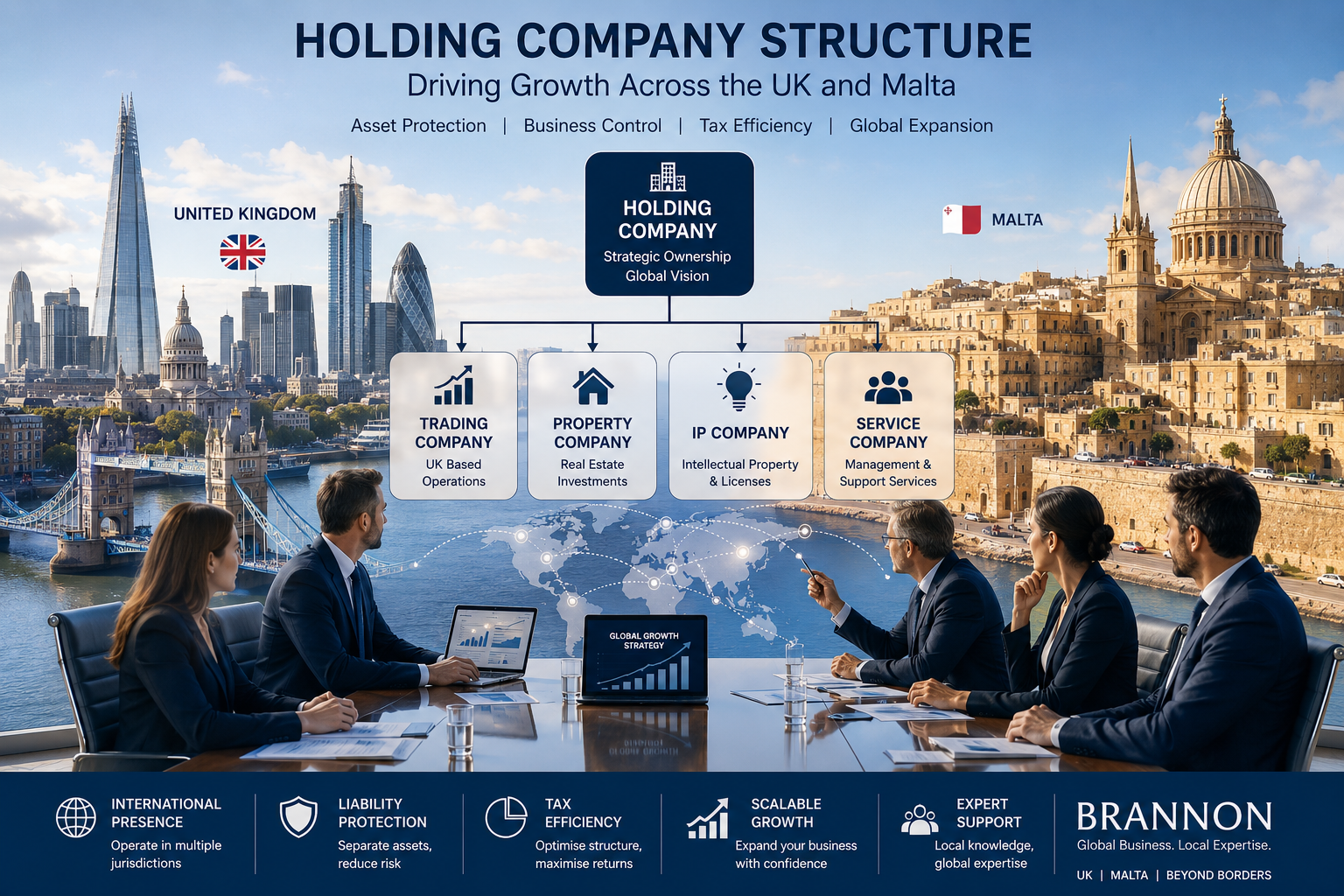
Malta offers EU membership benefits, access to European markets, a transparent regulatory framework, and competitive effective corporate tax via refundable imputation, making it attractive for holding and trading companies; Gibraltar, by contrast, provides an English-law jurisdiction, low headline tax rates, streamlined company formation and close ties to the UK, suiting trading and fintech firms seeking straightforward compliance-choice depends on market access, tax planning model and regulatory priorities.
Key Takeaways:

- Tax and cost: Gibraltar offers competitive, low headline taxes and a simple fiscal regime that suits small, consumer-facing or online businesses; Malta’s 35% statutory rate is offset by a full-imputation refund system that can produce very low effective rates for trading, holding and fund structures.
- Market access and regulation: Malta is an EU member with EU regulatory frameworks, passporting and an extensive DTT network-better for pan-European operations and regulated financial services; Gibraltar (post‑Brexit) has lighter EU oversight but no EU passporting and a more limited treaty network.
- Practical fit and reputation: Choose Malta for funds, holding companies and firms needing EU credibility and banking integration; choose Gibraltar for gaming/crypto/SME setups seeking simpler compliance and lower operating footprints-but account for substance requirements and possible banking/correspondent limitations.
Overview of Gibraltar and Malta
Gibraltar and Malta should be compared with other workable structures. Our guides cover UK, Ireland and Wyoming company formation for a broader benchmark.
Historical Background
Gibraltar was ceded to Britain under the 1713 Treaty of Utrecht and evolved from a military outpost into a services-led economy with a population around 34,000; Malta, ruled by the Knights Hospitaller and later Britain, gained independence in 1964 and joined the EU in 2004, now numbering roughly 520,000 residents. Their maritime histories shaped legal, fiscal and regulatory traditions that underpin today’s corporate attractions.
Political Structures and Governance
Gibraltar is a British Overseas Territory with domestic self-government under the 2006 Constitution-local parliament and Chief Minister handle internal affairs while the UK retains defense and foreign policy; it left the EU framework after Brexit. Malta is a unitary parliamentary republic, the Prime Minister runs government policy, and EU membership (and euro adoption in 2008) subjects Malta to EU law and single-market rules.
Regulatory consequences differ: Gibraltar’s autonomy lets it set local tax and licensing regimes (notably for iGaming and fintech) but its international treaty access is limited by UK-managed foreign relations; Malta’s EU status grants passporting benefits and alignment with EU directives, enforced by the MFSA, which helps attract cross-border financial services and multinationals seeking seamless EU market access.
Economic Environments
Gibraltar’s economy centers on financial services, online gaming, shipping and tourism, with a low headline corporate tax rate (around 10%) and no VAT; Malta’s economy is diversified across finance, iGaming, aviation, maritime services and life sciences, operating under a 35% headline corporate tax with imputation/refund mechanisms that often reduce effective rates for international shareholders.
Business implications are tangible: Gibraltar’s VAT-free status and streamlined licensing lower operating costs for e‑commerce and gaming firms, while Malta’s EU membership, MFSA oversight, and extensive treaty network support larger-scale financial and shipping operations; both jurisdictions offer targeted incentives‑R&D credits and investment schemes in Malta, and tax allowances plus residence caps in Gibraltar-making choice sector- and strategy-dependent.
Legal Framework for Corporations
Company Registration Processes
Gibraltar companies register with the Gibraltar Companies Registry, filing Memorandum and Articles, director/shareholder details, registered office and beneficial owner information; incorporation commonly completes in 24–72 hours when documents are in order. Malta uses the Malta Business Registry (MBR) with a similar submission set plus a declaration of compliance; practical turnaround often runs 3–10 working days, though expedited agent-led filings can shorten that.
Regulatory Compliance and Reporting Requirements
Gibraltar oversight comes from the Gibraltar Financial Services Commission (GFSC) and Malta from the Malta Financial Services Authority (MFSA); both require annual returns, submission of accounts and beneficial ownership registers, and AML/KYC records. Filing deadlines and penalties vary, so multinationals typically calendar monthly checklists to avoid fines and reputational risks.
More granularly, audit obligations differ: small-company exemptions apply but thresholds and criteria vary by jurisdiction, and regulated sectors (financial services, gaming, fintech) face quarterly or real-time reporting-Gibraltar applies sectoral prudential reporting under GFSC rules, while Malta’s MFSA enforces conduct and capital reporting plus Pillar 3 disclosures where applicable.
Intellectual Property Laws
Both jurisdictions grant standard IP protections-trademarks, copyrights and designs-but routes differ: Malta businesses can use national filings or EUIPO for EU trademarks/designs, gaining EU-wide protection; Gibraltar entities often need UK or international registrations post-Brexit and rely on UK/international systems for broad coverage.
Enforcement is civil-focused: injunctions, damages and border measures are available in both systems, with Malta benefiting from EU enforcement mechanisms (e.g., Customs action) and Gibraltar relying on domestic courts and international treaties-practical strategy often combines national filings plus WIPO or EU/UK filings to secure multi-jurisdictional rights.
Taxation Policies
Corporate Tax Rates
Gibraltar applies a straightforward 10% corporate tax for most resident trading companies, delivering predictable headline liability; Malta’s statutory rate is 35%, but Malta’s full-imputation and refund mechanism commonly reduces effective tax on distributed trading profits to roughly 5–10% for international shareholders.
Tax Incentives and Benefits
Gibraltar targets incentives at sectors such as online gaming, shipping and associated IP, keeping compliance light and rates low, while Malta combines participation exemptions, patent-box-like treatments and R&D supports with its refund system to favor holding, financing and IP-rich structures.
For example, Malta’s participation exemption can eliminate tax on qualifying dividends and capital gains, and combined with refundable tax credits and R&D allowances it becomes attractive for multinational holding and IP companies; Gibraltar’s regime, by contrast, is often chosen for licensing operations and gaming firms that benefit from simple 10% taxation plus sector-specific deductions and fast licensing turnarounds.
International Tax Treaties
Malta maintains an extensive double tax treaty and information-exchange network (over 70 agreements) and benefits from EU directives that can remove withholding on intra‑EU flows; Gibraltar has a much smaller DTA footprint and relies more on bilateral TIEAs and domestic reliefs, which can leave source-country withholding risks.
Practically, Malta’s treaties and EU membership mean common outcomes such as 0–15% withholding caps and MAP access for disputes, easing cross-border repatriation for EU and treaty partners; by comparison, Gibraltar structures must plan around potential withholding and fewer treaty credits, often using Malta or other treaty-rich jurisdictions as intermediary holding companies to secure lower withholding and stronger dispute-resolution remedies.
Business Environment
Availability of Skilled Workforce
Gibraltar’s labour pool is compact-around 34,000 residents-but highly specialised in finance, iGaming and maritime sectors and augmented by roughly 10,000 daily cross‑border commuters from Spain. Malta, with a population exceeding 500,000, supplies a deeper pipeline of EU‑trained talent in fintech, ICT and gaming, backed by targeted vocational schemes and the University of Malta; firms often recruit from both local graduates and EU/third‑country specialists under streamlined relocation processes.
Infrastructure and Connectivity
Malta offers an international airport (MLA) with frequent direct flights to major European hubs and the Malta Freeport as an EU transshipment node, while Gibraltar has daily UK air links, fast road/rail access into Andalusia and a compact port; both jurisdictions sit on submarine fibre routes to Italy and Spain, providing reliable broadband and low‑latency links for financial and gaming operations.
Gibraltar’s 1.8 km runway limits large widebody services, directing heavier cargo and long‑haul flights to nearby Málaga (1 hour by road), whereas Malta’s airport handles larger seasonal traffic and direct cargo connections. Data centre capacity in Malta has expanded to serve EU compliance needs, while Gibraltar focuses on secure hosting for regulated gaming and fintech firms, often leveraging UK‑centric compliance frameworks and specialised telecom providers.
Quality of Life and Living Costs
Housing supply is tight in Gibraltar, driving residential prices and rents above regional norms; Malta sees higher population density in Sliema and St Julian’s with prime rents typically €1,000-€2,000 monthly. Both offer English as a working language, robust healthcare systems (Gibraltar Health Authority; Malta’s Mater Dei), and a Mediterranean lifestyle attractive to relocating executives, though everyday goods can be pricier due to import dependence.
Families relocating for headquarters often cite Malta’s broader schooling options-state, private and several international schools-and warmer expat communities, while Gibraltar wins for short commutes and proximity to UK services. Grocery and utility bills in both locations can exceed mainland Spanish or Italian costs by 10–30%, making salary and allowance structures an important part of relocation packages for senior staff.
Financial Services Sector
Banking Systems
Gibraltar maintains a compact banking sector with fewer than ten licensed banks, focused on private banking, corporate lending and niche cross-border services; the Gibraltar International Bank supplements private-sector banks for local liquidity. Malta hosts a broader system of over twenty licensed banks, ranging from Bank of Valletta to international subsidiaries, with significant institutions falling under the ECB’s Single Supervisory Mechanism and offering full euro-based clearing and correspondent networks across the EU.
Investment Opportunities
Malta’s funds and wealth-management market leverages EU passporting for UCITS and AIFs and the Virtual Financial Assets Act (2018) to attract fintech and tokenization projects. Gibraltar, meanwhile, used its 2018 DLT regulatory framework to land crypto exchanges and gaming-related finance, creating specialist fund and custody opportunities for digital-asset and betting-sector investors.
Tax and structuring drive divergent propositions: Malta’s 35% headline corporate tax with refund mechanisms often yields effective rates near 5–10% for international shareholders, making it attractive for fund domiciliation and holding structures; Gibraltar’s competitive single-rate approach and lighter banking footprint suit companies seeking a streamlined 10% corporate-tax environment and direct access to UK-style legal frameworks for fintech and reinsurance deals.
Regulatory Oversight
The MFSA enforces EU-aligned prudential, AML and consumer-protection rules across Malta’s financial firms and coordinates with EU authorities; Gibraltar’s Financial Services Commission provides targeted supervision, emphasizing DLT, insurance and gaming sectors while maintaining close cooperation with UK regulators and international bodies such as the FATF.
In practice, Maltese oversight emphasizes cross-border consistency and EU reporting-useful when passporting funds or banks into the Single Market-whereas Gibraltar’s regulator offers faster, specialist licensing in emerging areas (DLT, iGaming) and bilateral supervisory memoranda with the UK and European peers; firms should map licensing timelines, AML expectations and passporting consequences when choosing between the two.
International Trade and Commerce
Trade Agreements and Partnerships
Malta’s membership of the EU single market (27 states) and access to EU free‑trade agreements and customs arrangements gives HQs immediate preferential access to dozens of markets and over 70 double taxation treaties; that simplifies intra‑EU supply chains and corporate structuring. Gibraltar, as a British Overseas Territory, relies mainly on UK treaties and bilateral arrangements with Spain and third parties, offering a narrower treaty network but streamlined arrangements for UK‑focused fintech and gaming operators.
Export and Import Regulations
Malta follows EU customs, tariff and VAT rules (standard VAT 18%), plus CE conformity and EU sanitary controls, so exporters use TARIC codes and the Single Administrative Document for declarations. Gibraltar sits outside the EU customs and VAT systems, with no EU VAT regime and customs formalities for goods moving to the EU; exporters therefore face additional checks and potential tariffs unless covered by UK/EU arrangements or specific bilateral protocols.
In practice that means Maltese manufacturers can move parts and finished goods tariff‑free across the EU and benefit from customs suspension procedures (e.g., customs warehousing, Inward Processing Relief). Importers into Malta clear via EU procedures, electronic declarations and the EU VAT return system. By contrast, a Gibraltar exporter to Spain now typically requires export declarations, possible certificates of origin and sanitary checks for foodstuffs; logistics costs and lead times can rise, and businesses often use bonded warehousing or re‑route via UK ports to manage cashflow and duty timing.
Impact of Brexit on Gibraltar
Since the end of the Brexit transition period (31 December 2020) Gibraltar lost EU membership benefits, affecting market access and regulatory alignment; passporting for financial services to the EU was removed and cross‑border trade with Spain faces customs formalities. Negotiations with Spain and the UK produced a 2023 framework to ease movement, but trade remains subject to new administrative and compliance costs.
The 2023 UK‑Spain framework envisages smoother border procedures and provisional arrangements on movement of people (Schengen‑related measures), which should reduce commuter delays affecting Gibraltar’s workforce. However, goods trade still lacks full EU customs union status: Gibraltar firms exporting to EU markets must manage customs declarations, potential tariffs under WTO or UK/EU rules, and divergent product markings (EU CE vs UKCA). Many Gibraltar financial, gaming and services firms have therefore restructured legal entities or established EU bases (e.g., Malta or Ireland) to retain frictionless access to the single market while keeping operational hubs in Gibraltar for UK‑centric business.
Information Technology Landscape
Digital Infrastructure
Malta benefits from multiple carrier-neutral data centers (notably BMIT) and a national fiber rollout that keeps latency to major EU hubs low, while Gibraltar relies on submarine cable links and low-latency routes to the UK and Spain but has limited land for large-scale colocation, making hybrid cloud and edge services common choices for HQs seeking redundancy.
Emerging Tech Startups
Malta’s “Blockchain Island” regulatory push and Startup Malta initiative drew fintech and blockchain firms after 2018, with a domestic market of ~515,000; Gibraltar’s 2018 DLT framework and entities like the Gibraltar Blockchain Exchange attracted crypto and iGaming startups despite a population near 34,000, producing lean, export‑oriented tech clusters.
Beyond headline regulations, ecosystems are supported by accelerators, coworking spaces and university links: University of Malta spinouts feed hardware/software projects, while Gibraltar leverages GBX and local incubators to commercialize DLT and betting-tech IP. Funding tends to be seed and angel-led; cross-border partnerships and remote talent hiring are common strategies to overcome shallow local pools, and several firms have scaled by targeting EU and UK markets early.
Support for Innovation and R&D
Malta Enterprise offers grants, equity and tax reliefs alongside EU research programmes and university collaboration, giving startups a clear commercialization path; Gibraltar’s government provides targeted innovation grants, skills funding and industry-focused support through Gibraltar Finance and partnerships with the University of Gibraltar, though scale is naturally smaller.
In practice, Maltese firms can tap EU Horizon and structural funds and use university tech-transfer services to move from prototype to market, while Gibraltar focuses on bespoke grants, co-funded pilot projects and regulatory sandboxes that speed time‑to‑market for DLT and iGaming R&D. Both jurisdictions emphasize applied R&D over basic science, favoring projects with short commercial horizons and export potential.
Tourism and Hospitality
Official regulatory and company information is available from the Gibraltar Financial Services Commission, the Malta Financial Services Authority and the Malta Business Registry.
Economic Impact of Tourism
Malta’s tourism engine-over 2.6 million visitors in 2019-drives large segments of accommodation, F&B and leisure, supporting extensive seasonal employment and investor interest in hotel conversions; Gibraltar, with far smaller overnight stays but strong day‑visitor and yacht traffic, generates high-margin retail and marina revenues that disproportionately benefit duty‑free outlets and luxury hospitality operators.
Business Travel Facilities
Malta offers robust MICE infrastructure-the Mediterranean Conference Centre in Valletta, extensive conference hotels and an airport handling over six million passengers in 2019-while Gibraltar relies on niche assets such as Sunborn Gibraltar and compact, high‑service venues, plus direct UK links and focused VIP handling for short executive trips.
Beyond venues, Malta provides comprehensive ground services: multiple international hotels with boardroom capacities, dedicated corporate transfer fleets, and established co‑working providers in St Julian’s and Sliema; Gibraltar compensates with rapid customs lanes, concentrated luxury accommodation for small delegations, and easy access to maritime berths for executive yachts, making short, high‑frequency business visits efficient.
Lifestyle Attractions for Executives
Valletta’s UNESCO core, Malta’s Blue Lagoon and Portomaso Marina present a Mediterranean lifestyle attractive to relocating executives, while Gibraltar’s Rock, Europa Point and duty‑free shopping offer compact leisure options and easy weekend escapes into Andalusia, supporting a high quality of life for short‑term and resident executives.
Executives find distinct advantages: Malta delivers a wide restaurant scene, historic concierge services and year‑round sailing events that suit family relocations and incentives; Gibraltar offers immediate access to premium marinas, private golf and proximity to Costa del Sol resorts within a two‑hour drive, facilitating quick leisure add‑ons to business trips.
Cultural and Social Factors
- Language mix: English official in both; Maltese official in Malta, Llanito/Spanish influences in Gibraltar.
- Population scale: Malta ~520,000; Gibraltar ~34,000-affects talent pools and office footprints.
- Regulatory-social context: Malta in the EU since 2004 and using the euro (2008); Gibraltar operates under UK jurisdiction and uses the Gibraltar pound/GBP.
- Industry clusters: strong iGaming and fintech presences in both, shaping local networks and events.
Language and Communication
English functions as the primary business language in both locations, easing legal, financial and corporate communications; Malta also lists Maltese as official, while Gibraltar’s day-to-day speech often mixes English with Llanito and Spanish, which can benefit firms targeting Spanish markets; Malta’s bilingual workforce and Gibraltar’s cross-border familiarity reduce translation costs and speed client onboarding.
Cultural Integration and Adaptation
Smaller populations and tight-knit business communities mean new headquarters must move quickly on local engagement: hiring local directors, aligning office hours with Mediterranean cultural norms, and planning social benefits that reflect island lifestyles; Malta’s EU membership (since 2004) tends to attract pan-European staff, while Gibraltar’s UK alignment draws UK-centric talent.
Onboarding programs that combine cultural briefings with practical support work best: examples include tailored expatriate orientation, partnerships with local HR firms for residency paperwork, and mentoring schemes linking international hires to established local managers; companies relocating to Malta often emphasize weekend-family integration and language classes, whereas Gibraltar-based firms prioritize commuting arrangements and bilingual client-facing training.
Community and Networking Opportunities
Both jurisdictions host active chambers of commerce and sector-specific associations, with frequent meetups for iGaming, fintech and professional services; Malta’s Malta Chamber and industry events attract EU and North African contacts, while Gibraltar’s smaller scene offers direct access to regulators and senior industry figures, enabling faster relationship building.
Firms benefit from targeted involvement: sponsoring Malta’s sector conferences or joining Gibraltar’s working groups on financial services yields rapid visibility; local incubators, legal clinics and networking breakfasts typically produce concrete leads within weeks, and cross-border firms often leverage both markets for complementary partner searches. Recognizing these social dynamics will sharpen recruitment, client development and stakeholder engagement plans.
Political and Economic Stability
Recent Political Developments
Gibraltar remains shaped by post‑Brexit negotiations with Spain and continued UK oversight, after the 2016 referendum where Gibraltar voted ~96% to remain; border cooperation talks and customs arrangements have defined recent policy. Malta, an EU member since 2004, faced intensified rule‑of‑law scrutiny and anti‑corruption pressure after the Daphne Caruana Galizia inquiry, prompting legislative and regulatory reforms aimed at transparency and financial‑crime controls.
Risk Assessment for Investors
Political risk profiles differ: Gibraltar (population ~34,000) benefits from UK backing and predictable tax rules but is exposed to bilateral Spain/UK frictions and concentrated sector risk; Malta (population ~520,000) offers EU market access and regulatory predictability yet carries legacy governance and reputational risks that demand enhanced compliance.
Investors should target operational risk drivers: iGaming, fintech and shipping face licensing scrutiny and AML checks in both jurisdictions. Due diligence should include verification of substance (local management, office, audited accounts), beneficial‑ownership reporting and contingency planning for cross‑border regulatory changes.
Economic Resilience During Crises
Both economies showed resilience in recent shocks: Malta leveraged EU ties and diversified services (financial services, gaming, tourism) to rebound quickly, while Gibraltar relied on fiscal reserves and its concentrated services base-online gaming and financial intermediation-to sustain activity during disruptions.
Case examples: Malta used EU frameworks and inward investment to accelerate recovery and reform sectors subject to EU AML reviews; Gibraltar maintained public finances and sectoral support to protect employment in core industries. For headquarters planning, evaluate cash‑flow buffers, access to single‑market mechanisms (Malta) versus UK support arrangements (Gibraltar).
Comparison of Corporate Case Studies
-
Case ID GIB-FIN-01 Sector FinTech payments Incorporation Year 2016 HQ Employees 45 FY Revenue €28,000,000 (FY 2023) Reported Effective Tax Rate ~10% Initial Setup Cost €120,000 Office Size 220 sqm Licensing / Time-to-Operate 8 months (payment services authorisation) Outcome / Notes Scaled payments into 8 international markets via partner bank integrations; processing costs down 14% after local banking relationships established. -
Case ID GIB-GAM-02 Sector Online gaming operator Incorporation Year 2012 HQ Employees 70 FY Revenue €95,000,000 (FY 2023) Reported Effective Tax Rate ~10% Initial Setup Cost €200,000 Office Size 450 sqm Licensing / Time-to-Operate 10 months (remote gaming licence) Outcome / Notes Achieved stable payment processing and reduced chargeback exposure; reported 18% reduction in payment fees after local bank agreements. -
Case ID GIB-HOLD-03 Sector International holding & trading Incorporation Year 2018 HQ Employees 12 FY Revenue €6,500,000 (trading margin) Reported Effective Tax Rate ~10% Initial Setup Cost €35,000 Office Size 40 sqm Licensing / Time-to-Operate 3 months (company registration + basic approvals) Outcome / Notes Fast incorporation enabled rapid subsidiary roll-outs; used regional banking corridors to optimize repatriation timing. -
Case ID MLT-IT-01 Sector iGaming platform Incorporation Year 2014 HQ Employees 120 FY Revenue €160,000,000 (FY 2023) Reported Effective Tax Rate ~5% (post-refund mechanisms) Initial Setup Cost €320,000 Office Size 900 sqm Licensing / Time-to-Operate 14 months (gaming licence & compliance build-out) Outcome / Notes Access to EU markets and multilingual talent pool supported rapid growth; headcount doubled in 24 months after licensing completed. -
Case ID MLT-FIN-02 Sector Financial services / wealth management Incorporation Year 2009 HQ Employees 28 FY Revenue €14,000,000 (FY 2023) Reported Effective Tax Rate ~6.8% (post-refund) Initial Setup Cost €95,000 Office Size 250 sqm Licensing / Time-to-Operate 12 months (financial licence + compliance) Outcome / Notes Benefit from EU regulatory frameworks and strong professional services network; client onboarding times averaged 11 days. -
Case ID MLT-TECH-03 Sector Blockchain / crypto exchange Incorporation Year 2020 HQ Employees 37 FY Revenue €22,000,000 (FY 2023) Reported Effective Tax Rate ~8.1% (post-refund) Initial Setup Cost €140,000 Office Size 300 sqm Licensing / Time-to-Operate 16 months (VFA licensing and AML build) Outcome / Notes Regulatory clarity attracted institutional clients; longer licensing stretched initial cash runway by ~6 months compared with expectations.
Successful Corporations in Gibraltar
Several Gibraltar-based firms-notably payments (GIB-FIN-01) and online gaming operators (GIB-GAM-02)-demonstrated rapid time-to-operate (3–10 months) and stable effective tax outcomes (~10%), enabling reinvestment into product and payment infrastructure; headquarters staffing tends to be lean (12–70 employees) with high revenue-per-employee ratios, driven by outsourcing and regional partnerships.
Successful Corporations in Malta
Maltese headquarters like MLT-IT-01 and MLT-FIN-02 show higher initial setup and licensing timelines (12–16 months) but materially lower reported effective tax after refund mechanisms (≈5–8%), supporting aggressive reinvestment and hiring-examples include headcount growth from 60 to 120 within two years.
Beyond effective taxation, Malta’s larger multilingual talent pool and EU-aligned regulatory frameworks enabled MLT-IT-01 to scale revenue to €160M with a 14-month licensing phase; firms reported average client onboarding times of 11 days and faster regional market access compared with non-EU alternatives, offsetting higher upfront costs.
Lessons Learned from Corporate Experiences
Case comparisons reveal trade-offs: Gibraltar delivers faster incorporation and lower setup friction, while Malta demands longer licensing but often yields lower post-refund effective tax and broader market access; companies planning cash runway should model licensing timelines (3 vs. 12–16 months) and initial cash burn accordingly.
Operationally, firms that budgeted an extra 6–9 months of operating capital fared better-GIB-HOLD-03 launched in three months with €35k setup, whereas MLT-TECH-03 required 16 months and €140k initial spend, increasing early burn. Strategic choices-banking relationships, talent availability, and regulatory alignment-were decisive: gaming firms prioritized Gibraltar for speed and payment stability, while EU-facing financial and tech groups prioritized Malta for EU market access and post-refund tax efficiency.
Future Trends and Predictions
Expected Economic Developments
Malta should continue leveraging EU market access and digital services growth, with forecasts pointing to steady GDP expansion driven by iGaming, fintech and blockchain hubs; Gibraltar’s growth will be more modest but marked by higher-value financial and trust services as it capitalizes on post‑Brexit regulatory clarity and remote‑worker inflows, making both jurisdictions attractive for different scales and types of headquarters.
Legislative Changes on the Horizon
Implementation of the OECD’s Pillar Two 15% global minimum tax, tighter AML directives (EU AMLD5/6) and expanded automatic exchange (DAC7) will force both Malta and Gibraltar to revise tax frameworks, substance rules and reporting regimes, reducing tax-planning gaps and increasing compliance costs for low-substance structures.
Practically, companies should expect new nexus tests, effective tax rate (ETR) calculations and minimum tax top-ups; Malta, as an EU member, will align directly with EU directives, while Gibraltar will adopt equivalent OECD/UK-aligned measures-legal teams now model Pillar Two impacts, adjusting financing, IP routing and payroll structures to preserve margins within the 15% threshold.
Evolving Corporate Strategies
Firms increasingly adopt hybrid setups: operational HQs in Malta for EU access and talent, paired with finance or holding functions in Gibraltar to exploit specialist trust and wealth services; emphasis shifts to demonstrable substance-local hires, leased office space and board meetings-to meet evolving substance and nexus criteria.
Advisors report rising use of multi-jurisdictional footprints, with treasury centres redesigned to pass new ETR tests, relocation of executive teams to satisfy management-and-control tests, and greater reliance on documented board minutes and employee contracts; expect more companies to publish substance reports and to restructure intra‑group financing to withstand audits under the new rules.
Advantages and Disadvantages of Each Location
Pros and Cons of Gibraltar
Gibraltar offers a low headline corporate tax (around 10% for many companies), no VAT, and a stable English common-law system attractive for fintech and gaming firms; downsides include a small local talent pool (population ~34,000), a limited double-tax treaty network, and growing substance and banking scrutiny that can raise operating costs.
Gibraltar: Pros and Cons
| Low headline corporate tax (~10%) | Limited double taxation treaty network |
| No VAT system | Small domestic talent pool (population ≈34,000) |
| English common-law legal framework | Dependence on UK relations and Brexit fallout |
| Competitive fintech & iGaming cluster | Banking relationships can be harder to secure |
| Relatively low company administration costs | Increasing substance and compliance expectations |
Pros and Cons of Malta
Malta combines EU membership and an extensive treaty network with a refundable tax system (statutory 35% with shareholder refunds often yielding effective 5–10%), strong financial-services infrastructure, and a multilingual workforce; trade-offs include heavier compliance complexity, standard VAT at 18%, and higher office and payroll costs versus smaller jurisdictions.
Malta: Pros and Cons
| Effective tax rates often 5–10% via refund system | Statutory corporate tax is 35% (refund mechanics add complexity) |
| EU membership and single-market access | More onerous EU-level compliance and reporting |
| Broad double-tax treaty network | Perception issues after AML/BEPS scrutiny |
| Skilled, multilingual labour force | Higher operational and office costs than micro-jurisdictions |
| Well-developed financial-services ecosystem | Substance and management presence often required |
Delving deeper, Malta has become a hub for holding companies, funds, and digital gaming-examples include multiple EU-facing gaming firms domiciled there-yet firms must model cash flow timing for tax refund claims and plan for substance (board meetings, local directors) to withstand audits and OECD scrutiny.
Malta: Further Pros and Cons
| Attractive for holding structures and EU-facing operations | Refund timing can stress cash flow for small entities |
| Access to EU passporting for certain services | Local substance expectations (office, staff, governance) |
| Established corporate service providers and advisors | Regulatory change risk from EU directives |
| Competitive incentives for funds and IP structures | Administrative burden for complex structures |
Weighting Key Factors for Decision Making
Prioritise areas that affect total cost and market access: effective tax after refunds and treaties, EU market access, substance costs, availability of specialised staff, and banking connectivity. Relevant examples: a pan‑EU SaaS firm may value Malta’s EU passporting; a B2C gaming operator might prefer Gibraltar’s niche ecosystem. The
- Tax efficiency (effective rate, treaty relief)
- Market access (EU membership, passporting)
- Substance & compliance costs (office, directors, audits)
- Banking and payment processing availability
- Talent availability and wage levels
Run quantitative scenarios: model a five‑year P&L comparing after‑tax profit, expected compliance spend, and hiring costs; include stress tests for refund delays or bank de‑risking. Use case studies‑e.g., an EU SaaS with €5m revenue vs a gaming firm with high payment volumes-to see trade-offs. The
- Scenario 1: Malta — strong EU access, effective low tax but higher compliance
- Scenario 2: Gibraltar — lower headline costs, niche ecosystem, tighter banking
- Decision rule: weight factors by predictable cash impact and regulatory risk
Final Words
For wider international business and market coverage, readers can also follow Michael Schmitt, Trider and the Malta Business Report.
Following this assessment, Gibraltar suits firms seeking strong legal certainty, low corporate tax and proximity to UK markets, while Malta offers EU membership, versatile corporate structures and broader access to EU talent and finance; choice depends on whether a company prioritizes EU market integration and regulatory alignment (Malta) or streamlined tax and legal predictability with UK ties (Gibraltar).
FAQ
Q: Which jurisdiction — Gibraltar or Malta — typically gives better tax outcomes for a corporate headquarters?
A: The optimal choice depends on your corporate structure and shareholder residence. Malta operates an imputation/refund tax system for shareholders that often produces low effective tax on distributed profits for international groups and offers an extensive double tax treaty network and EU VAT regime. Gibraltar uses a territorial-style system with favorable corporate taxation and limited or no VAT equivalent, which can lower on-paper tax costs for certain activities but provides a smaller treaty network. If EU market access, VAT treatment, and treaty relief are priorities, Malta is generally stronger; if you want a simple low-tax, territory-based regime and your operations or clients are outside the EU, Gibraltar can be attractive. Assess withholding taxes, dividend refund mechanics (Malta), treaty availability, and the residence of ultimate shareholders when modelling effective tax burden.
Q: How do substance, management, and anti-abuse requirements compare between the two?
A: Both jurisdictions have strengthened economic substance and anti-avoidance standards following international reforms. Malta enforces clear residency and management requirements for tax residency with oversight consistent with EU/OECD standards; substance expectations include local directors, physical premises, and adequate decision-making. Gibraltar has implemented substance rules and public registers, requiring demonstrable local activity, qualified staff, and governance aligned with international transparency initiatives. Gibraltar’s smaller size means substance costs (office space, hires) may be proportionally higher for some headquarters functions, while Malta’s larger professional services market can be easier for scaling compliance and demonstrating central management and control.
Q: What are the regulatory, reputational, and market-access differences to consider?
A: Malta benefits from EU membership and single-market alignment for goods and services where EU regulatory frameworks (including GDPR, financial services directives when applicable) apply; this supports reputational acceptance within EU markets but also subjects companies to EU compliance regimes. Malta’s financial services sector is well-developed with robust regulatory oversight. Gibraltar follows UK-style regulatory approaches and is widely used for fintech, gaming, and cross-border trading with the UK and international partners; its reputation is solid in niche sectors but fewer EU-specific authorisations are available. Consider client perception, sector licensing requirements (financial services, gaming, payment services), and the impact of EU versus UK regulatory passports when choosing headquarters location.
Q: What practical business considerations — banking, talent, language, costs, and infrastructure — differ between Gibraltar and Malta?
A: Both jurisdictions use English as a primary language for business and law. Malta offers a larger pool of multilingual professionals, established corporate service providers, international banks, and academic institutions supplying local talent; office and living costs are moderate and scale better for larger teams. Gibraltar provides proximity to the UK and Spain, strong English-speaking skills, and a business-friendly environment, but has a smaller labour pool and limited commercial real estate, which may require cross-border commuting or higher per-head costs. Banking accessibility has improved in both locations but may require robust substance documentation; Malta’s EU banking integration can ease euro-denominated operations while Gibraltar’s banking relationships tend to be regionally focused.
Q: What is the typical process, timeline, and major cost drivers for establishing a headquarters in each jurisdiction?
A: Steps are broadly similar: corporate incorporation or redomiciliation; appointment of directors and company secretary; registering for tax and any sector licenses; opening bank accounts; securing premises and hiring staff; and implementing compliance frameworks. Timelines range from a few weeks for a simple incorporation to several months for licensing, bank onboarding, and building demonstrable substance. Major cost drivers are staff salaries, office rental, licensing fees, professional advisory fees, and compliance/reporting costs. Malta often requires more extensive documentation for EU regulatory compliance but benefits from a mature supplier market that can streamline setup; Gibraltar can be faster for basic incorporations but may incur higher per-capita costs for local staff and office capacity. Plan budgets for ongoing substance and reporting, not just initial incorporation fees.