For more than a decade, I’ve been proud to be a veteran of working from home. I’m not one of those newbies forced into the world of remote work by a global pandemic, awkwardly balancing a laptop on the ironing board or turning the spare bedroom into a sterile office.
No, I’ve worked from home long enough to see trends come and go, to witness the rise and fall of the “work from couch” movement and the inevitable return of some people to physical offices in the face of isolation are tired of. Despite all of this, I remained consistent with my setup—a sturdy desk, a good chair, and, let’s face it, way too many snacks within reach.
But the winds of change are relentless and it seems that not even I could resist them forever. So, after all these years, I write to you from a standing desk, elegant as a modern-day labor martyr, my feet sliding on a treadmill beneath me. Just thinking about it would have made me roll my eyes a few years ago. Standing desks and treadmills? What are we, lab rats? But after working from home for so long, there came a point where even the most experienced remote worker had to admit: something had to change.
I guess it all started with the excruciating pain that crept into my body that I had ignored for a long time. I’m no stranger to stubbornness — who would be after working from home for so long? There is a certain pride, or perhaps delusion, in having your home office locked up the way you want it to be.
But while I had embraced freedom, my body had silently declared rebellion. Sitting endlessly – sometimes for hours – had done me no favors. Let’s not mince words: Sitting in front of a screen in the same chair for years can have unspeakable effects on your posture, your back, and your waistline. And as the days turned into years, these little aches and pains turned into a quiet hum that followed me until one day I realized: Well, next year I’ll be fifty, I was no longer a sprightly young thing, but rather someone who now grimaced every time they got up from their desk.
Enter the standing desk
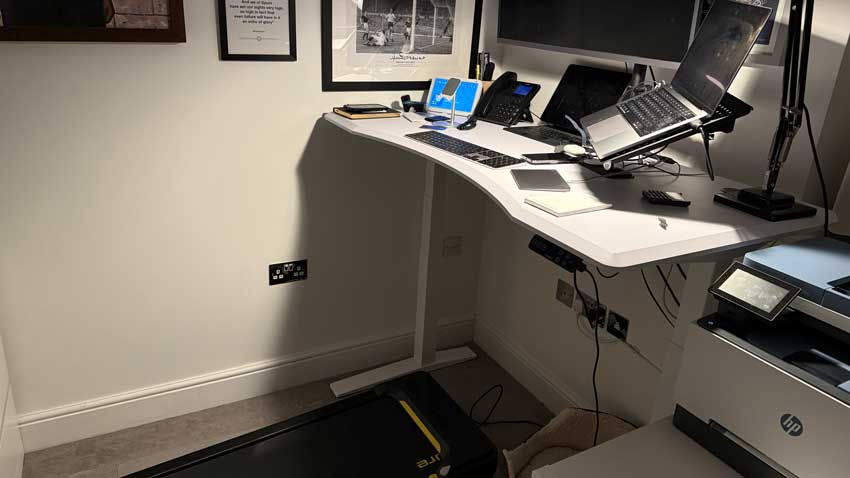
The thing that caught my eye was this FlexiSpot E7 Proa pretty sleek machine that promised to solve all my problems and I haven’t looked back. Adjustable at the touch of a button, sturdy as a tank and with enough space for my many notebooks, coffee mugs, podcasting microphones, GoPro camera and all the other associated technology I need for weekly deliveries All EV Podcast for EV Powered for our 100,000+ listeners. I liked the idea of being able to change my position throughout the day — up when I needed to concentrate and down when I needed to relax (or, you know, read the news and pretend it was). research).
I have to admit that standing up felt revolutionary. After years of slumping in my chair, albeit a plush Herman Miller Aeron from the days when we had our physical office in Canary Wharf that I trudged to every day. Here I was upright, alert, and feeling like I had unlocked some kind of productivity superpower. I noticed that I was moving more naturally, shifting my weight, stretching, and even becoming a little more engaged with what was happening on the screen in front of me. My legs stopped feeling so restless and dare I say my back even felt better. It’s actually a simple change, but one that has made a noticeable difference in the way I approach my workday. I no longer feel like I’m stuck in one place for hours, slowly melting into the chair like some kind of office furniture chimera.
Of course, standing alone wasn’t enough to completely disrupt my routine. If I wanted to become a true wellness guru, I figured I might as well go all the way and invest in a treadmill. Yes, that’s right, I became one of those people — the ones who type while walking slowly and steadily like a hamster on a wheel. At first it seemed ridiculous to me that I would have something like that with a cheeky G’n’t before the pandemic friends mocked. But as my treadmill hums quietly beneath me, I have to admit that the novelty has quickly worn off and been replaced by a real sense of purpose.
There’s almost something meditative about it, the gentle rhythm of the belt beneath your feet as you go about your day. I no longer feel like my body is being held hostage by my desk. Instead, I’m constantly moving, albeit at a moderate pace — my average is around 10 km/h. It’s not about breaking a sweat (although that might come in handy during a particularly stressful deadline). It’s about moving, keeping the blood flowing, and not succumbing to the pain and lethargy that can so easily come on during long, motionless days.
It hasn’t turned my life into a montage of fitness magazine perfection, but it’s a subtle change that has made me feel better, more energized, and, frankly, a little smug with my setup. After years of believing I did everything right, I realize that maybe it’s not about committing to one way of working forever. Change is good, even for us old remote working dogs. And who knows, maybe in a few years I’ll write another article extolling the virtues of a new device I swore I’d never adopt.
For now, though, I’m just going to be there, stand tall, and take it all in stride. Literally.
Richard Alvin
Richard Alvin is a serial entrepreneur, former UK Government Small Business Adviser and Honorary Teaching Fellow in Economics at Lancaster University. A winner of the London Chamber of Commerce Businessman of the Year award and a Freeman of the City of London for his services to business and charity. Richard is also Group MD of Capital Business Media and SME business research firm Trends Research, recognized as one of the UK’s leading experts in the SME sector and an active angel investor and advisor to start-up businesses. Richard is also the host of the US business advice show Save Our Business.