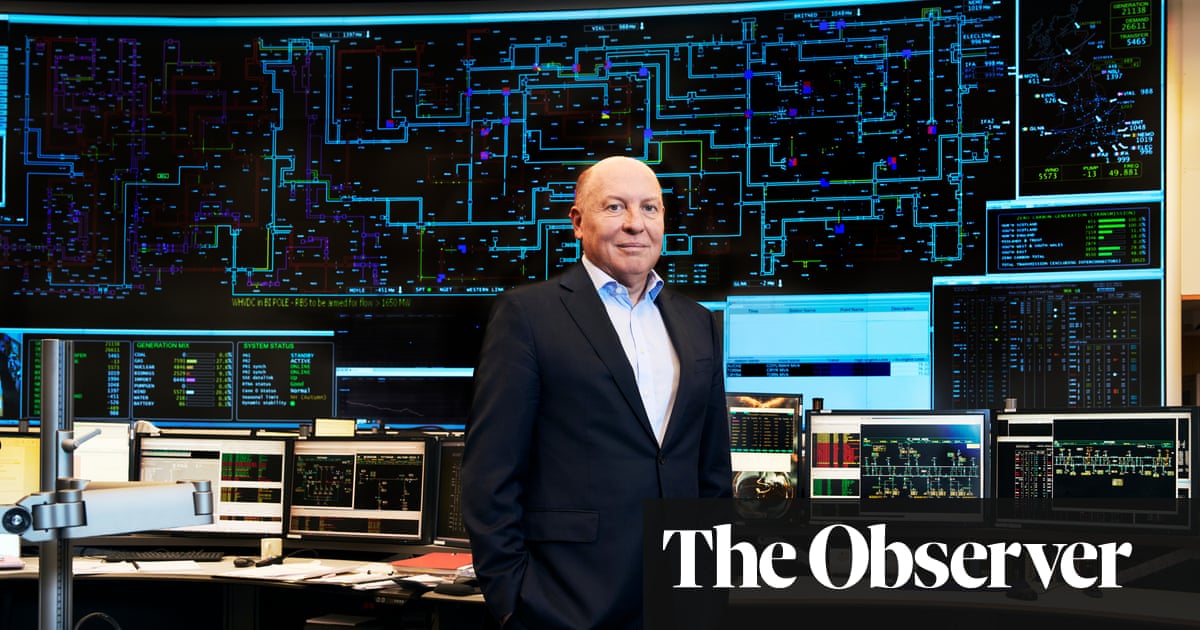
The dense network of Britain’s electricity grid looms over the control room floor on giant digital screens showing every pulse of the country’s power system.
This nondescript office building in rural Berkshire, which houses National Grid’s control center, has been watching Britain’s transition away from fossil fuels for more than 30 years.
The electricity grid operator is also changing. The company responsible for keeping Britain’s lights on has broken away from energy group National Grid — and from Tuesday October 1 will be known as the National Energy System Operator (Neso), a public company with the mandate to implement the government’s green energy agenda.
If the man tasked with turning Energy Secretary Ed Miliband’s dream of a clean energy system by 2030 into reality has any concerns about the scale of the challenge, he isn’t showing it. In the Wokingham control room, Fintan Slye looks at the screens: power plants are running, turbines are turning and electricity is flowing through Britain’s submarine cables.
A small corner of a screen shows Britain’s last remaining coal-fired power station, Ratcliffe-on-Soar in Nottinghamshire, quietly producing a tiny fraction of the grid’s electricity. “We won’t see this for long,” says Slye. The power plant was finally shut down on Monday.
Slye has been responsible for the operation of the UK’s electricity networks since taking up the role of managing director of the electricity network operator in 2018, which he had taken up in his home country of Ireland. He says he still misses being close to the sea in Dublin. But the chance to lead Britain towards a low-carbon future will take priority for now.
The first task facing Neso will be to put in place a plan to decarbonise UK electricity. In its first weeks in office, the government tasked Slye and his team with drawing up the roadmap that will take the UK into a clean energy era by 2030, including the difficult changes that will be required to the UK’s planning and regulatory systems.
This plan will serve as the basis for a wider strategy for Britain’s ailing energy infrastructure and will be part of an effort to break down the fragmented thinking that has hampered progress to date and chart a holistic future for Britain’s energy. For the first time, the system operator will have a say in shaping the landscape he controls.
This is “absolutely” the biggest challenge for the new organization, says Slye. “We have a new government with a really clear mission of what it wants to achieve in the energy sector. It was one of the main points of their election manifesto and it is one of their most important tasks now that they are in power. But achieving clean electricity by 2030 is undoubtedly very ambitious. To do this, we not only have to do everything we can faster, but also do it very, very differently.”
Many in the industry would describe the task as insurmountable. If Slye is to meet this challenge within the government’s timeframe, an unprecedented effort will be required, they say. Slye admits there is a “huge level of skepticism” which has already led many to believe the plans are “fantastic and unworkable”. But he firmly believes they can be delivered.
“Is it at the very limit of what is possible? Yes. But if you’re willing to do things differently and make difficult decisions early on, then it’s definitely doable,” he says.
“This will most likely include things like a complete reform of the planning and approval system, a streamlining of the regulatory approval process, changes to the grid connection process…” The list goes on.
“So we are not saying that the goal is achievable with the energy industry’s current processes, systems and working methods. In fact, it is unreachable under these circumstances. But if you can make the necessary changes, it can be delivered,” says Slye.
When he moved to the UK in 2018, gas was the largest source of electricity in the UK, accounting for almost 40% of total electricity generation. Five years later, it still accounts for almost a third of the total. But over the next five years, Slye will have to push him into a supporting role.
Of course the power grid must be clean, but it must also keep the lights on reliably while remaining affordable and shockproof. The upcoming roadmap will likely include two or three routes, offering different strategies with different costs and challenges to achieve the same goal. Ultimately it is up to ministers to decide which path to take.
One thing these routes will not deliver on is the “carbon-free electricity system” promised by Labor before the election – at least not always. Since coming to power, ministers have made subtle changes to rhetoric and decided to talk about “clean energy” by the end of the decade. This is arguably a more flexible goal.
“There is no established definition of clean electricity,” says Slye. “So what does that mean realistically? One of the key pieces of work from the Climate Change Committee found that as you reach the final percentage points towards 100% clean energy, the costs (of decarbonization) really start to rise.
“Currently the working definition we use for this analysis is to achieve 95% clean electricity. This means that by 2030, 95% of the UK’s annual generation will come from clean energy sources. And that means the remaining 5% will come from unabated gas. That’s our definition.”
There will still be “a significant amount” of gas-fired power stations available for the cold, cloudy and windless winter weeks, but they will only run for limited periods, says Slye. Conversely, there will be days when the UK generates significantly more electricity from renewable energy sources than it can consume or store, meaning larger exports to neighboring countries can be expected.
after newsletter advertising
But achieving a power grid that is 95% decarbonized by 2030 will pose enormous challenges – particularly the “creaky” legacy systems and regulations that have been made obsolete by the growth of the green energy industry. Owners of assets such as grid batteries have been vocal in their criticism of the operator, accusing the control room of continuing to favor old power plants when newer, cleaner technologies could do the job.
Britain’s electricity grid was built around its coalfields, with coal-fired power stations connected to homes via a vast transmission network and regional distribution networks. The shift from fossil fuel energy to intermittent renewable energy has made it more difficult to maintain the stability of the grid, forcing the grid operator to try new measures, including making payments to large consumers to increase or reduce their consumption at certain times.
Today, renewables account for just over half of Britain’s electricity, but by 2030 this share is expected to rise to around two-thirds as more wind farms and solar panels are connected to the grid.
“There are problems,” Slye agrees. “But it’s not a bias or culture issue. The reality is that due to the scale of change that has taken place in the UK’s electricity generation portfolio, IT systems have not kept up. The systems we have today were designed to spread a small number of really large gas or coal-fired power plants across a much larger number of smaller energy sources. We went from needing to send five instructions per hour to sending 500 instructions per hour. It creaks.”
Requests from new smaller energy projects to connect to the grid are processed on a first come, first served basis, resulting in the process becoming clogged with “zombie projects” that are unwilling to move forward but have a place in have the queue ahead of those who could.
“These old processes were fine when only two or three generators were coming online each year, but right now the queue is over 700 gigawatts and heading towards 800 gigawatts,” says Slye. “We wrote to everyone who had hoped to be connected to the transmission grid that they must be ready to be connected within two years — this prompted half of the ‘zombie projects’ to admit they were not ready , and to take a step.” back. … But we need the new reforms coming through.”
As reforms and regulations are implemented, Neso is consulting with the market, regulators and government on interim changes that could ease frustrations.
“There is an old perception that system operators live in their ivory tower in some kind of command and control role,” says Slye. “We have already started down the path and are becoming more open. All the things we talk about are much bigger than what we can solve ourselves.
CV
Old 54
Family Married to Jenny, two children.
Training Engineering degree; Masters in Engineering; Diploma in Law; Diploma in European Law; Master in Business Administration.
Pay £273,000
Last holiday Cornwall (Padstow) late August.
Biggest regret I didn’t go to the 1994 World Cup to see Ireland beat Italy.
Best advice he got “It’s all about people. Also, don’t swing at every pitch.”
Sentence that he overuses “Are we just drinking our own Kool-Aid?”
How he relaxes “Music. I bought a record player, am rebuilding my vinyl collection from my youth and am trying to learn guitar.”