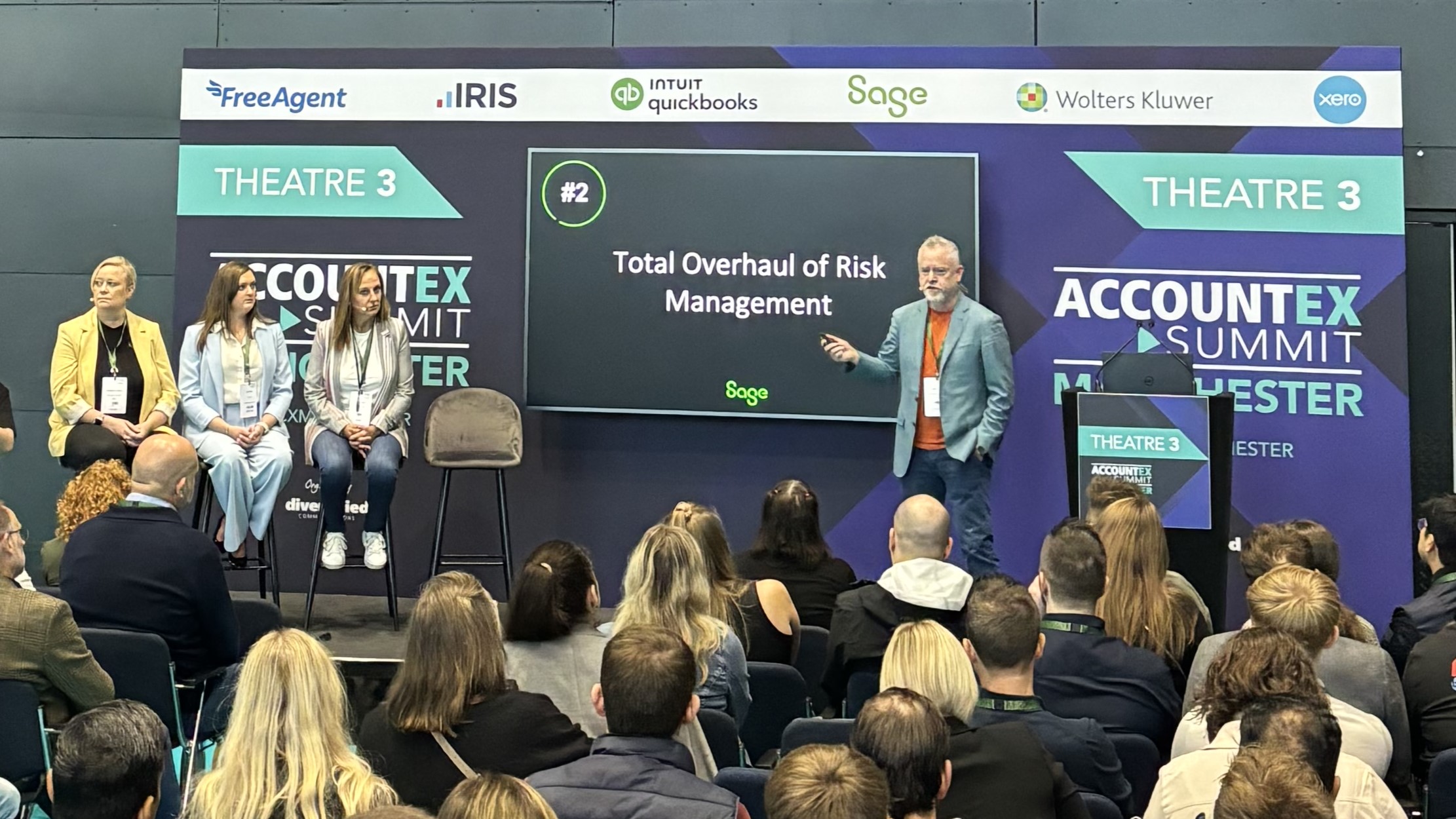
Didn’t have a chance to stop by Accountex Manchester 2024 on Tuesday 17th September?
Don’t worry: in this blog we cover the most important points to consider.
The keynotes in four cinema halls had a strong focus on personal branding and acquiring new clients, perhaps reflecting a subtle shift in the way accountants and bookkeepers view their profession.
Still, and as expected, tax topics and the burgeoning field of AI breakthroughs dominated many sessions. Accountants and bookkeepers need to be aware of this and act quickly and decisively.
This article introduces three major updates. First, the latest from the AI keynote “AI is not the future”.
Here’s what we’ll cover
AI is here now
It is top of mind among professionals around the world.
As part of the keynote “AI is not the future; We’ll show you how it’s changing the accounting industry today.”Sage CTO Aaron Harris said of the latest advances in AI:
“Business accounting is on the verge of a transformative era driven by the rapid integration of artificial intelligence.
AI is poised to further redefine the role of accountants, evolving from traditional, numerical tasks to strategic advisors that drive business growth.”
Aaron Harris, CTO of Sage
He explained how a recent report from Sage and ACCA, along with the upcoming Sage Practice of Now report, has revealed a wave of optimism among accountants and accountants about artificial intelligence in accounting.
An impressive 61% of respondents see more opportunities than risks and 68% are confident in their ability to adapt.
Building on the previously mentioned research, Aaron predicted the future AI landscape and its impact on accounting by 2030:
- Increased creation of new roles and opportunities for accountants: AI will automate routine tasks, allowing accountants to focus on strategic thinking and gain valuable business insights.
- The end of the month-end closing:Real-time data will replace traditional month-end closing, with 75% of SMBs moving to dynamic, continuous accounting practices. The transition depends on the success of continuous backup. As AI revolutionizes risk management, real-time reconciliation and other assurance capabilities become possible.
- Real-time data will drive financial decisions:Over 70% of SMBs will integrate real-time data into financial decisions, driving growth and innovation to thrive in the competitive environment of 2030.
- Ethical AI leadership will be a priority:With 80% of SMEs having adopted a strict AI ethics policy, ethical AI will no longer be negotiable by 2030. However, companies will not only adopt ethical AI policies, but also become the leading force in ethical AI security.
Action points
Karen Ainley, SVP of Accountants at Sage, joined Aaron for the keynote discussion to explain how the company is working closely with customers to develop Sage Copilot, our new AI assistant tool.
This is done through the Accountants Early Adopter Program for Sage Copilot. If you would like to experience this groundbreaking technology first-hand and begin the important process of evolving yourself and your team, we highly recommend registering today.
Ultimately, there are three commandments for every accountant or accountant going forward:
1. Refer to the new AI
You need to understand what is being offered and how it impacts workflows.
Your customers are just as fascinated by AI as you are and face the same challenges.
Can you answer their questions?
After all, you are, and always have been, the path to new accounting technologies for most of your customers.
2. First try out the new AI yourself
See how well the new AI works in your own business and your own finances.
This also enables further qualifications so that you are always one step ahead.
As mentioned, Sage Copilot’s early access program is ready and waiting for you.
Accountants and bookkeepers can sign up for the Sage for Accountants free plan and then add Copilot to the free Sage Accounting license that you get as part of the package.
3. Get fast customer data streams 24/7
Data is the oxygen of AI, and without it, AI tools simply wouldn’t be as effective.
As we discussed, digitizing customers is no longer an option, especially in the era of tax digitization.
Can you be confident your customers are providing the data flow you need for an AI-powered future?
How can you achieve this?
Practice of the now
As previously mentioned, Sage Accountex used Manchester to highlight some fascinating data points from its new Practice of Now report.
The Practice of Now is a global trends update for 2024 and 2025, highlighting how accountants and bookkeepers are navigating a changing world.
Opportunities are being sought to embrace these changes and unlock the potential of becoming an accountant or accountant of the future.
Here’s just a small selection of the results ahead of the upcoming release:
- 96% of accountants say the industry and their role will change in the next five years.
- 92% spend too much time on manual administration and compliance tasks, diverting their focus from strategic or advisory roles.
- 89% say integrating AI-powered tools or machine learning would make a real difference in improving their roles.
- 85% would like more opportunities in consulting and strategy work.
Digitize taxes for income tax
Finally, we are now less than two years away from the introduction of the MTD on income tax for sole traders and landlords earning more than £50,000.
In his keynote, “An update from HMRC”, Jonathan Athow, general manager of client strategy and tax design, discussed the organisation’s “digital first” approach, manifested in the upcoming introduction of MTD for income tax.
“We want to make it easy to get the tax right and harder to get it wrong, and that ties into our digital journey,” he said.
He reiterated HMRC’s belief that there will be free software for making income tax digital, but added that this would only be for those with “the simplest of matters”.
“We have a commitment that we will have some kind of free software. But I don’t want to give the impression that there will be free software for everyone (…) We urge people to invest in software.”
He said he expected bridging software — typically plugins for Microsoft Excel to enable MTD filing — to be available as part of a “large and vibrant” software offering, but added caveats.
“We want to make it as easy as possible for people to get started with the system.
It will be the right solution for some people, but whether it will be the long-term solution for everyone, I don’t know.”
There has been much uncertainty surrounding MTD for income tax, including its implementation date and the details of its operation.
Both have been adjusted several times in recent years.
Athow said there was no reason why HMRC would not meet the April 2026 deadline, but warned it was a “large and complex programme”.
“If we had problems, we would probably eliminate certain groups,” he added. “If nothing goes wrong with our IT setup, we will deliver in April 2026.”
He further explained how HMRC has been doing since April 2024 Inviting sole proprietors and landlords to voluntary registration and added: “It works. We have people who do quarterly updates. So we know the technology works.”
Early registration makes a lot of sense and gives accountants the opportunity to try out the new requirements and correct any errors before the legal obligation arises. If mistakes creep in, there are also penalties.
Other discussion points Athow mentioned include:
- There will be no specific exemptions for pensioners, apart from the existing disability-related exemptions.
- There was no talk of a soft landing period like Making Tax Digital for VAT, with Athow explaining: “The moment you switch to MTD (for income tax), you switch to the penalty version.” This is the points system already established for VAT.
- The upcoming multi-agent authorization system should mean agents can access more customer data, but while a separate work stream is running to give agents more insight and capabilities, this is not part of MTD — so agents remain fundamentally limited for now.
The most important requirements for digitizing income tax are summarized in our guide here.
Action points
There is little doubt that accountants and bookkeepers need to take the digitization of income tax seriously. Here are some suggestions to get you started:
1. Start testing MTD for Income Tax with clients
A full tax cycle lasts 22 months, from start to latest possible payment date.
Therefore, it is already too late to test a full MTD for the income tax cycle with a client before it becomes mandatory in April 2026.
But as they say, the best time to act was yesterday, but the second best time is today.
Since April this year, you and your clients have been able to voluntarily register for income tax with MTD. If you haven’t already, you can start today.
2. Start segmenting your customer list
To survive MTD’s introduction of VAT in 2019, understanding how customers think about technology was crucial.
Use this experience for MTD for income tax planning and start segmenting your client list so you can calculate the amount of work required to serve your clients.
For example, some customers are tech-savvy and will welcome MTD for income tax without hesitation.
They hardly require any input from you.
Many others are familiar with the technology and already use digital ledgers, but are not experts. You need at least education.
Finally, there will be a significant portion for whom accounting and the technology associated with it are abhorrent.
These are the customers who require the most work and should therefore be prioritized well before April 2026 (if they have an income over £50,000).
3. It’s time for enlightenment
As with MTD for VAT, HMRC rather cheekily relies on accountants and bookkeepers to handle the majority of client communications around MTD for Income Tax.
And we can again learn a lot from MTD’s experiences for VAT. Email blasts, webinars, social networking posts, in-person pub events combined with business networking… it’s all at your fingertips.
The same goes for simply incorporating a discussion about MTD for income tax into client conversations.
Adding a mention to your email signature can also lead to more discussions with customers.
Final thoughts
It was a busy Accountex Manchester this year with lots of insights into current topics such as AI and MTD for income tax, providing some practical insights and useful preparation points for the year ahead.
Check back regularly for more updates on the latest accounting news.