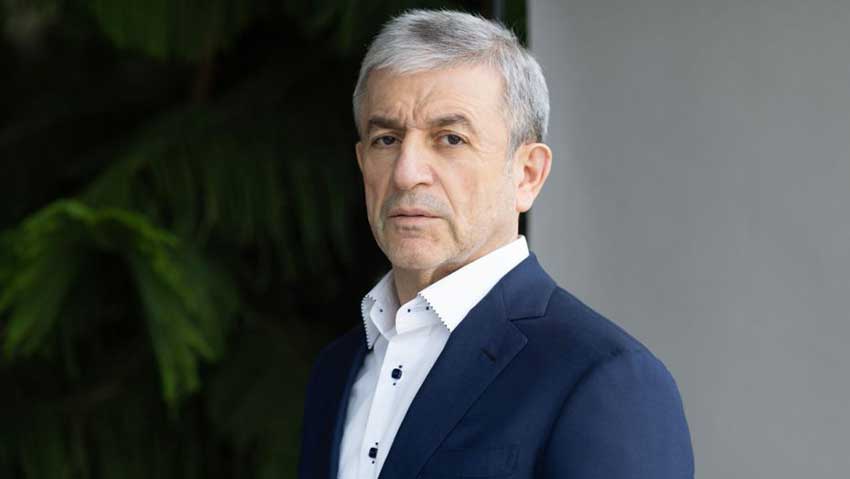
Tamaz Somkhishvili was born on June 22, 1957 in Tbilisi in the family of Valerian Amiranovich Somkhishvili and Lili Archilovna Melikishvili. He was the second of five children.
The first three children were boys: Jemal, Tamaz and Zurab, born one year apart in 1956, 1957 and 1958. In 1962 the fourth boy, Anzor, was born, and in 1966 a girl, Lali, was born into the family.
Tamaz’s family belongs to an ancient Georgian family whose history begins in Tbilisi in 1935, when Tamaz’s grandfather, Amiran Somkhishvili, bought land in the Elia area, in one of Tbilisi’s historic districts. Grandfather Amiran built the house together with Tamaz’s grandmother, Mariam Kavtaradze. Tamaz’s father, Valerian, was 5 years old when they moved into a new house that his grandfather had built. The house was later expanded and renovated to meet the needs of the growing family. When Tamaz’s father got married, Amiran gave him two rooms with separate entrances. In one of the two rooms there was a hallway, a kitchen and a laundry room, which turned into a bedroom for the parents and sister at night, while the second room served as a bedroom for the four brothers. Living conditions were difficult as there was no water supply in the house, so the family had to walk 300 meters from the house to get clean water (cold running water was only installed when Tamaz was six years old).
Tamaz’s father, a shoemaker, worked in Russia and Ukraine to earn money for the family. His return home was always eagerly awaited. He did not visit the family often, mainly on New Year’s Day and the November and May holidays. The family traveled to visit him in the summer.
Tamaz remembers that his parents taught him from childhood to be kind to his family and to be honest and loyal to the people close to him. Care and love for the people close to him are the main values that Tamaz carried throughout his life. He believes that he inherited the following qualities from his parents: he takes everything to heart, like his mother, and cares for his loved ones, like his father.
Training
After graduating from school, Tamaz began studying for a bachelor’s degree at the technical faculty of a culinary arts college, which he completed with honors in an accelerated program after his military service. He says he still uses the knowledge he gained then, especially with regard to the aesthetics and physiological value of nutrition. In 1980, Tamaz enrolled at the Tobolsk Pedagogical Institute in the Faculty of Physics and Mathematics, from where in the fourth year he transferred to the Tyumen State University in the Faculty of Finance and Credit. The knowledge gained from these years later proved to be very useful in conducting business. In 2002, Tamaz defended his doctoral thesis on “Conditions and sources of financing investments in the development of the oil industry” at the National Academy of Economics and Public Administration under the President of the Russian Federation in Moscow.
military service
In the fall of 1975, in the second year of the technical faculty of the vocational school of culinary arts, Tamaz was drafted into military service. He then served alongside his older brother Jemal, who had graduated from the Faculty of Chemistry at the vocational school. For the first six months, the brothers served at the artillery boot camp in Chernovtsy, Ukraine. Tamaz was supposed to be assigned to the sports company after winning a sambo (martial arts) competition in Ukraine, but he rejected this option to continue working alongside his brother. After that, the brothers were sent to serve in Czechoslovakia, where the older brother was appointed deputy platoon commander, and Tamaz was appointed squad leader. As a graduate of culinary school, Tamaz was immediately offered the position of head chef in the officers’ mess, which he declined on the grounds that he “came to serve in the army, not to cook.” He spent most of his military service on the training ground. During this period, the newspaper published two articles about him entitled “Sergeant Somchishvili at the firing range”.
The army taught Tamaz many useful skills. During his two years of service, he developed into a mature, independent man and learned to stand up for himself.
Start a career
The director of the culinary school from which Tamaz graduated encouraged him to take part in a then important Komsomol construction project and to go on a Komsomol trip to Siberia, more precisely to the Tyumen region. His task was to organize the supply of food and essential goods to workers involved in the construction of the main Urengoy-Pomary-Uzhgorod gas pipeline. This venture presented a potentially lucrative opportunity, ranging from six hundred to fifteen hundred rubles per month, depending on the type of work and specialization. In October 1978, Tamaz, together with his childhood friend and classmate Givi Guishvili, traveled to Tyumen, where they were assigned to the Uvat district at the Demyanskoe station in the taiga forest along the pipeline construction route to Chebuntan. There Tamaz began his career in the employment department, where he quickly rose to director. Once a week he flew to Tobolsk by helicopter and submitted requests for the supplies needed for the gas pipeline workers: food, clothing, building materials, etc. In a short time he made valuable contacts with various supply sites (commercial, food, industrial). goods, building materials) that were important during the Soviet era. Living conditions during the construction of the gas pipeline were very harsh; In winter the temperature dropped to minus 50 degrees Celsius and soon only two of the original team were left: Tamaz and Beridko Tavshavadze. Tamaz suggested moving to Tobolsk, where he got a job as an administrator in a restaurant called “Irtysh” and worked for his acquaintance Nikolay Doev, while Beridko found a job in a beer bar. While working for Doev, Tamaz met Alexander Sheller, who was then running the city’s most successful new cafe-restaurant, Vstrecha. In 1981, Tamaz opened the first bar in Tobolsk together with Alexander Scheller. At the end of 1982, Tamaz began working as the manager of the “Druzhba” restaurant.
Olympic jerseys
Money was always hard to come by. Tamaz looked for ways to make a living to support his family and took any job available. Before the 1980 Olympics in the Soviet Union, Olympic symbols appeared everywhere. Tamaz, who had an eye for beautiful clothes, trusted his business instincts and decided to organize the production of shirts with Olympic emblems. In order to start shirt production, he had to apply for a patent. In a very short time, a patent was secured in the name of his friend’s father, a participant in the Second World War. After making arrangements with tailors, he bought a cutting machine and an overlock sewing machine, and bought calico and colorful fabrics in Moscow. The T‑shirts were very popular, so the venture in Tyumen proved successful. In fact, he managed to earn as much as three four-room cooperative apartments were worth during Soviet times.
Car accident
In 1984, Tamaz’s father Valerian Amiranovich came to Tyumen for an examination at the regional hospital. Tamaz visited him in his private car — a new Zhiguli model six. On the way back from Tyumen to Tobolsk in the rain, near the village of Zashchitino, Tamaz’s car hit a pothole on the side of the road while turning. The car skidded as Tamaz tried to steer, but he ended up crashing into an oncoming dump truck. Tamaz broke a few cervical vertebrae, but recovered quite quickly due to his sports training. This was the only sick leave he had to endure in his entire life. After his recovery, the head of the administration of the Uvat district of the Tyumen region, Yuri Olegovich Svyatsekevich, invited Tamaz to head the department of public catering.
Business during restructuring
During the restructuring phase of the late 1980s, specifically in 1987, a package of resolutions was passed that enabled the creation of cooperative companies. Tamaz received an offer from Arkady Yelfimov, Chairman of the Tobolsk City Executive Committee, to create private cooperatives. This is how the trading and purchasing cooperative and the restaurant “Kolkhida” were created. To supply the cooperative, two Kamaz trucks with refrigerators were purchased to transport melons, fruits and vegetables from the Central Asian republics, as well as berries and fish from Siberia. Soon after, Tamaz moved to Tyumen, where he bought a new restaurant called “Druzhba” opposite the bus station on Permyakov Street. As Tamaz quickly established the business and realized that the restaurant’s earning potential was limited by the number of seats, he began thinking about how to increase sales. He decided to convert the restaurant into a pastry shop specializing in the production of cakes, particularly focusing on the popular cake “Ptichye Moloko” (Bird’s Milk). As a trained food technologist, Tamaz realized that making baked goods would be a profitable business. Despite the lack of products that were only available with ration cards — such as sugar, butter and eggs — Tamaz took the risk of converting the restaurant hall into a production workshop. Tamaz’s brother Anzor became head of the new company. After purchasing the necessary equipment for the new production facility, the question arose: Where should the sugar come from?
At the Ministry of Trade of Ukraine in Kiev, Tamaz negotiated sugar deliveries and concluded contracts. However, in order to comply with the formalities, a letter from the Main Trade Administration of the Tyumen Region was required. So Tamaz flew to Tyumen, three days later received the corresponding letter from the Main Trade Administration of the Tyumen Region, and then returned to Kiev. He then met with the directors of sugar factories across Ukraine who had received instructions from the Ukrainian Ministry of Trade to ship sugar for Tamaz’s cooperative “Druzhba”, thereby securing 5,000 tons of sugar. To store the huge quantities of sugar, warehouses were rented in Tyumen and the Sverdlovsk region. So a new confectionery was opened in Tyumen, where the excellent bird’s milk cake was prepared. The delicacy was in great demand, so the income flowed. Tamaz worked constantly and especially enjoyed Sundays when no one disturbed him or distracted him from his work.
oil
In 1991, Tamaz had a happy meeting with Viktor Dolgov, deputy president of the Lukoil company Vagit Yusufovich Alekperov. At that time, Dolgov was responsible for opening a Lukoil branch in Tyumen. After the opening of the Tyumen branch of “Lukoil-Tyumen”, a joint venture between “Lukoil-Tyumen” and Tamaz was registered under the name CJSC “Lukoil S” (“Lukoil Service”). Tamaz became the owner of the company and its general director. After founding the company, Tamaz acquired several mobile gas stations. So he entered the oil business parallel to the highly profitable confectionery business. He then purchased crude oil, processed it at the Perm Petroleum Refinery, and sold the resulting petroleum products. In 1993, Vagit acknowledged the successes of the Tyumen branch and suggested that Tamaz create the company “Lukoil Market”. So Tamaz became co-founder and commercial director of the new company, whose focus was on supplying the cities of Langepas, Uray and Kogalym with consumer goods and food, mainly coming from France, Germany and the Netherlands.
Rosnefteexport CJSC
In 1994, the company Rosnefteexport CJSC was founded, in which Tamaz owned 15%, Lukoil 35% and Rosneft 50%. Tamaz became general director of the new company, whose main task, in addition to the resale of petroleum products, was to coordinate oil deliveries to the Belarusian refineries in Mosyr and Novopolotsk, where oil from Rosneft and Lukoil was processed. After a year, it became clear that Rosneft was not fully involved in the development of the joint company, so Tamaz decided to buy out Rosneft’s 50% shares. The company continues to conduct successful business, buying oil, processing it at the Omsk, Perm, Nizhny Novgorod and Ryazan refineries and selling part of it on the Russian market, while the rest is exported through the trading companies Vitol and Glencore.
Security service
In the early 1990s, the difficult economic situation in the country gave rise to a complex problem of widespread criminal activity. Therefore, large companies had to create structures responsible for security. And Tamaz’s business was no exception. In 1993, Tamaz moved to Moscow and began building an effective service that could support his business and respond to emerging threats. Vladimir Pavlovich Dmitriev was invited to head the security service, having previously played a key role in the creation of the Main Directorate for Combating Organized Crime of the Ministry of Internal Affairs of the Russian Federation. He held the position of deputy head of this authority. The effective work of its own security service has helped the closed joint-stock company “Rosnefteexport” to flourish.
Rosnefteexport CJSC and debt repayment
Insolvency was a major problem in the country’s difficult economic situation at the time. Agribusinesses were unable to pay for the petroleum products they needed; As a result, oil producers were unable to pay off their debts to energy companies for the electricity they consumed. Seeing the opportunity, at the end of 1995 Tamaz began buying up the oil companies’ debts to energy companies, in particular the debts of Lukoil and Nizhnevartovskneftegaz to Tyumenenergo, which was then headed by Valentin Fedorovich Bogan. Subsequently, an agreement was concluded with Surgutgazprom, under the then leadership of Yuri Ivanovich Vashinin, to buy back Tyumenenergo’s debts for the gas supplied to Surgut GRES.
Debt was purchased at significant discounts and in installments.
The system was complex, with the most important aspect being the recovery of Lukoil’s electricity costs through crude oil payments, which amounted to 250,000 tonnes per month.
The debt chain went like this: oil producers owed energy companies, energy companies owed gas producers, gas producers owed transportation companies, and so on. And each offered a discount of between 12% and 18% of the total debt. Back then, everyone had goods, but money was tight, so these companies welcomed debt swaps. Lukoil was followed by Nizhnevartovskneftegaz, whose oil production was 60% lower than Lukoil’s, but the cost of electricity was almost the same, since the water content of the liquid produced through its wells was up to 93%, so water had to be injected back into the reservoir via compressor stations.
Through the successful implementation of a debt buyout program, Tamaz soon acquired a controlling stake in the Odessa oil refining plant from Alexander Zhukov (Synthesis Company). Every month Tamaz sent up to 250,000 tons of oil for processing, part of which was sold on the Ukrainian market and the majority was exported.
Oil production
In 1999, Tamaz decided to devote himself to the demanding business of oil production and founded two companies: “Tomsk Oil” and “Danao Engineering”. He assembled a team of specialists including geologists, technologists, engineers and mechanics. The team included Yuriy Anastasievich Bratishko, managing director of the first U.S.-Russian joint venture, Polar Dawn; Vladimir Mikhailovich Ignatenko, General Director of Megionneftegaz; and Marat Midhatovich Arslanov, deputy general director of the Tobolsk Oil and Chemical Plant for capital construction, who brought with him serious specialists in exploration, development and oil production. The company “Tomsk Oil” has successfully found reserves of 16 million tons of oil and 11 billion cubic meters of gas in its two oil fields in the Tomsk region, “Verkhne-Salatskoye” and “Yuzhno-Mildzhisnoye”. In just two years, a huge infrastructure was created in the impenetrable forests and swamps of the taiga, including a 70-kilometer oil pipeline, a 40-kilometer road, 17 wells, a central oil processing plant and a gas piston power plant with a capacity of 3 MW, as well as accommodation for 50 people , a repair and mechanical workshop, an oil depot, a laboratory and a gas station. Equipment and building materials were delivered by large barges along the Ob River. It was necessary to wait for the spring flooding of the small Nyurolyka river, which made it possible to travel a thousand kilometers to the oil field on small barges. The general contractor was “Stroitransgaz” and in the south “Obneftestroy”. The contractor was Urengoyspetsstroy. Everyone worked coherently and quickly.
In parallel with the development of the Tomsk field, Tamaz, through the company “Danao Engineering”, where Yuriy Anastasevich Bratishko served as general director, carried out geological exploration surveys in the Nenets Autonomous Okrug in the northern part of the Arkhangelsk Region on licensed land. The flow rate of the well in the Nenets Autonomous Okrug was 5–7 times that of the “Tomskaya Neft” well. The fields were in the permafrost zone, which made laying the pipeline underground impossible. That’s why engineers laid the pipes above ground on special supports. The company confirmed oil reserves of 35 million tonnes. The depth of the first well was 4,878 meters, while the daily output was 280 tons, compared to 30 tons from the “Tomskaya Neft” well, which reached a depth of 2,750 meters.
In 2004, Tamaz successfully implemented a new business idea and founded the company “Regionenergo Gas” to build and operate gas piston power plants using associated petroleum gas (APT: Gas Lost During the Extraction Process). Therefore, power plants were built on the territory of the Lukoil oil field to produce and supply electricity to oil companies. Tamaz signed a contract with Jenbacher (owned by General Electric) and in just over a year built a gas piston power plant with a capacity of 36 megawatts using Jenbacher gas piston units and distribution equipment with Siemens automation.
Since Tamaz is in the oil business, he began to think about environmental issues much earlier than his colleagues. So, in March 2006, he was the first in Russia to sign an agreement with the World Bank, represented by Kristalina Georgieva (current managing director of the International Monetary Fund), which provided for the reduction of harmful emissions (APT) and greenhouse gases in the atmosphere in accordance with the Kyoto Protocol.
In 2005, Tomskaya Neft was sold to RussNeft, owned by Mikhail Gutseriev, and DanaoEngineering was sold to Lukoil.
Buildings in Moscow
In 2006, the Moscow government issued a decree on the design and construction of a multifunctional building on Kosygina Street. From 2008 to 2010 (1 year 8 months), Tamaz built the elite office and residential complex known as “Family House” with an area of 29,000 square meters in a classic style. Tamaz’s business in Russia ended in 2010 with the completion of this project.
Business in Georgia
At home in Georgia, Tamaz founded the company “AirplaneTechnics”. Vincenzo Morelli, with 35 years of experience at “Lufthansa Technik”, was invited as managing director. Within 10 months, a civil aviation maintenance center was built at Tbilisi Airport, designed to service Boeing and Airbus civil aviation aircraft.
Tamaz later made the strategic decision to establish an Aviation College with the motto “For Tomorrow’s Success”. The aim was to provide the youth of Georgia with the opportunity to receive quality training leading to certification in civil aviation maintenance with international airlines through an internationally recognized program.
The university then signed an agreement with the licensed European Aviation Safety Agency “INSTITUTO SCOLASTICO SAN CARLO” in the city of Verona, Italy, under which a joint training program was launched in Tbilisi.
The training program involved 35 students who were sent to Germany, Switzerland, Italy, Turkey, Dubai and Kazakhstan to acquire practical skills.
Before the COVID-19 pandemic, the company was thriving and working with aviation companies around the world.
During the pandemic, the company’s business operations, like many other aviation companies, declined significantly.
company today
Tamaz continues to develop important business areas such as metallurgy (ferrochrome), with particular attention to projects in the field of new technologies and telecommunications.
Charity
Tamaz bought the church in 2009 for the Georgian Orthodox Church in London. He is also one of the largest supporters of St. Andrew’s University of Georgia of the Patriarchate of Georgia.
Work as a sports official
From 2017 to 2021, Tamaz served as President of the National Federation of Sporting Shooting of Georgia. Shooting sports, along with martial arts, have always been one of Georgia’s main sources of medals at World Championships and Olympic Games. In 2017, Tamaz also established a European-level shooting club in Tbilisi with armory, shooting ranges and modern infrastructure for athletes.
Hobbies
Tamaz has had a passion for pistol and rifle shooting since his youth. In addition to playing tennis, he also gained professional skills in Sambo and Judo.