

March 29, 2023
This article was written by Jade Beech for Cornwall Living magazine. For more information about how RRL can help, please contact us at 01872 276116 / 01736 339322 or post@rrlcornwall.co.uk.
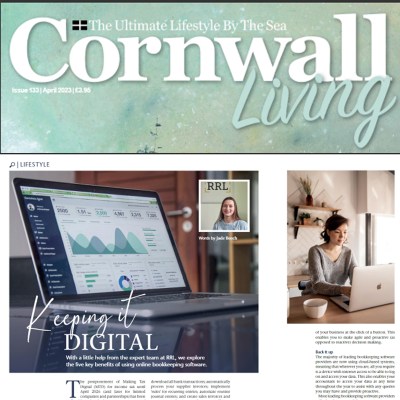
Our editorial appears in Cornwall Living Magazine this month and examines the five key benefits of using online accounting software.
The postponement of Making Tax Digital (MTD) for income tax to April 2026 (and later for limited companies and partnerships) has been widely publicized and the subject of intense scrutiny. While this reprieve (and we’re sure it will only be a reprieve) may have been a welcome relief for those who don’t already keep digital records, switching to online accounting software offers a number of benefits that will add even more to your business could benefit So why wait until 2026?
Here we explore our five key benefits of using online accounting software.
- Save time
The majority of time spent accounting without online accounting software is a very manual and repetitive process.
Most online accounting software systems use technology to automate time-consuming, repetitive tasks, providing significant efficiency benefits and reducing accuracy by reducing the problems of human error. Examples of this are:
- Automatic bank feeds that download all bank transactions
- Data extraction software – automatic processing of your supplier invoices
- the use of “rules” for recurring entries
- Automating routine journal entries;
- Sales Invoice Creation – Create and send invoices and send reminders for more efficient collection of funds.
- User friendly
One of the most important benefits for business owners is that you don’t have to be an accountant to use most online accounting software. Generally there is a short learning curve and plenty of support from the provider (as well as support from your accountant).
- Monitor business performance
With manual accounting, this typically occurs once a year and can be a labor-intensive task as it involves compiling outdated data. With continuous computerized accounting, you have the ability to create accurate, meaningful reports with real-time data, allowing you to closely monitor your business’s performance at the touch of a button.
This allows you to be agile and proactive (as opposed to reactive) in decision making.
- The cloud
Most leading accounting software providers now use cloud-based systems. This means that no matter where you are, all you need is a device with internet access to log in and access your data. This also gives your accountant access to your data at any time throughout the year to support you with any questions and provide proactive advice (provided they have the necessary advisory expertise, which we do).
Most leading accounting software providers also have a mobile app, so you can log in, upload documents, and monitor financial performance on the go.
- Digital storage
Documents can be scanned and saved to the software, or PDF attachments received via email can simply be “pulled in.” Not only does digitally stored records eliminate the need to store all of your paperwork in files and boxes (which take up valuable space and can be easily misplaced), you can also easily search for invoices in the software and view, reprint, and resend invoices when needed. Storing records digitally saves you time, space and money.
This also has significant sustainability benefits by reducing unnecessary printing and paper usage.
Are you already using accounting software?
Many businesses have already made the switch to online accounting software, but may not be taking advantage of all the benefits it offers. For example:
- Bank Feeds – Connections that allow you to automatically import transactions from your bank directly into your accounting software so you can reconcile them every day. This eliminates the need to manually post bank transactions (saving time) and reduces the risk of human error.
- Departments – many companies have multiple stores but cannot accurately track the financial performance of each individual store. By using departments in your accounting software, you can easily assign each transaction to the appropriate business. You would then have the ability to create departmental reports to show (as an example) an individual profit and loss account for each trade, a valuable tool in financial and business decisions.
If you would like to discuss any of the above in more detail or need help choosing the right accounting software for you and your business, we at RRL are happy to help.
This article was written by Jade Beech, RRL LLP. published for Cornwall Living magazine, March 16, 2023 (page 98):

