


In the United Kingdom, Companies House is a government body responsible for the creation, maintenance and dissolution of limited companies and for publishing key company information, which is regularly updated to promote the transparency and legitimacy of the UK economy. In order to do this, Companies House requires all registered limited companies to file both statutory accounts and a confirmation statement, reporting any material changes directly to them. To avoid your company being struck off the Companies House register, follow our instructions for filing your confirmation statement.
What is a confirmation statement?
The confirmation statement is a formal document that you must submit to Companies House at least every 12 months and “confirms” that a company or LLP (limited liability partnership) information currently held at Companies House is correct and accurate.
It is not primarily intended for you to make corrections to the company information as it should have been reported at that time, but some changes may be made. However, it is strongly recommended as a best practice Report changes as quickly as possible and then, if necessary, confirm this via the confirmation declaration.
What company information must be included?

Most of the information that must be included in your confirmation statement relates to who owns and is responsible for the company’s activities. The good news is that Companies House provides a standardized form (known as Form CS01) which means you don’t have to remember all the information you need to provide, you can simply go through the form and fill in the relevant sections. The information you must review and confirm on your confirmation statement includes:
- The registered office of the company as well as Single Alternative Inspection Location (SAIL) If necessary, provide address. A SAIL is an address where you can store your legally required business registers and which must be available for public inspection. It is not always practical for this location to coincide with the company’s registered address so that a SAIL can be listed on the confirmation statement.
- The company’s senior executives These are the directors, a company secretary (if one has been officially appointed) and any members.
- A SIC code (Standard Industrial Classification).. This is an official five-digit code assigned to each specific industry and the various trading activities in which your company may be involved. You will need to choose the most appropriate SIC code for your business, although in some cases you may be able to list more than one. Companies House offers one complete list of available SIC codes to choose from, including specific codes for dormant or non-trading companies.
- Information for shareholders, including the Name of each shareholder, number of shares of each shareholder owns as well the share class and all Share transfer details.
- The Share capitalalso known as the capital statement, is the financial report that shows the face value of the company’s shares — in other words, how much the company is worth in terms of the money invested by the owners. Limited liability companies are “limited by shares,” meaning that shareholders are personally liable for the value of their contributions. Those setting up a new limited company will typically issue 100 shares at £1 each, or even just 1 share at £100 for a single company. Man-band companies in which one person is the sole director and sole shareholder.
- A list of People with Significant Control (PSCs) unless your company is exempt. A PSC is anyone who holds more than 25% of the shares in a company, holds more than 25% of the voting rights in a company or has the right to appoint or remove a majority of the board. Even if you are the sole director and shareholder of your own limited company, you must register as a PSC.
What is annual return and is it the same as a confirmation statement?
You may have come across the term “annual return” before, and if so, it may sound incredibly similar to an endorsement statement. Sometimes an annual return is still referred to or the term is used interchangeably with the annual confirmation statement. This is because the confirmation statement in June 2016 actually replaced the annual return. Although both perform the same function, there are still differences.
The confirmation declaration is now much more convenient to fill out than the annual declaration used to be. This is especially true if you have not made any changes to your business in the last 12 months, as you can simply state that no changes have been made and all existing information about the business remains correct. With the annual declaration, however, you would have to fill out the entire form again every year, even if the information was identical.
In addition, you are now also required to publicly disclose all PSCs in the confirmation statement, whereas previously this was not required in the annual return.
From March 2024, companies will also now be required to provide a registered email address, but this will not be published on the public register and is for Companies House internal use only.
How to file a confirmation statement with Companies House
To file a confirmation statement you can use Companies House WebFiling online service. You must register and log in for online filing. However, if this is your first time doing this, you can simply create a new account, which requires an email address.
Once you’ve logged in, you’ll have two options. If this is your first time applying, you will first need to add your business under “Your Businesses”.
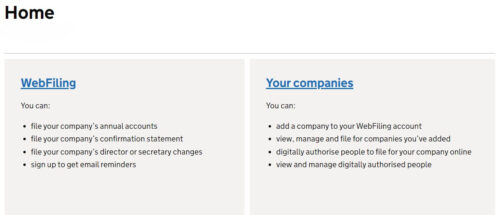
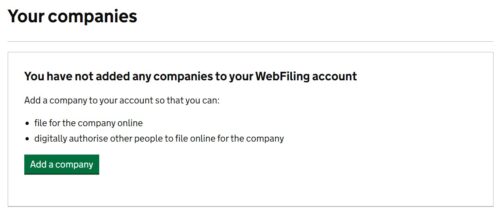
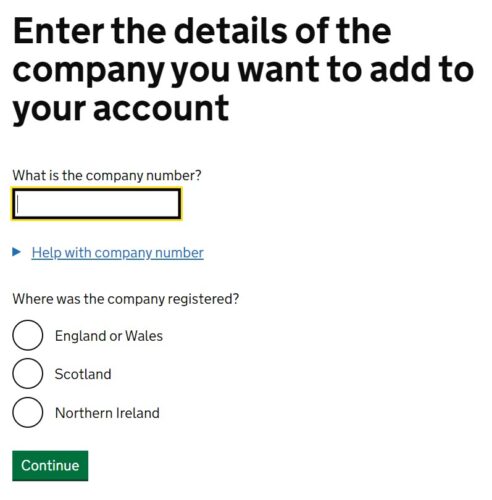
You will need your company number, which can be found on the certificate of incorporation issued to you when you registered with Companies House.
To ensure that you only connect to a company for which you are authorized to file, the WebFiling service will prompt you to enter the authentication code. This is a 6‑digit alphanumeric code sent to you by Companies House when you registered (note this is sent separately to your certificate of incorporation).
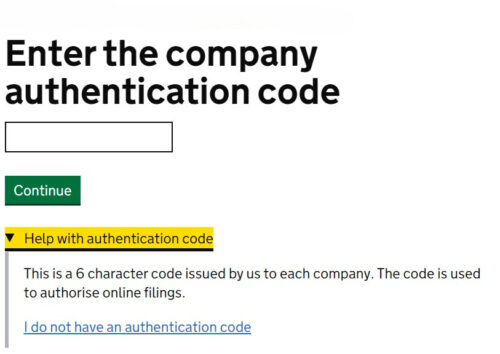
Make sure you have your authentication code ready before your verification statement is due. This is because it can take up to 5 working days to resend by post, and even longer during busy periods. The authentication code cannot be transmitted via email or telephone.
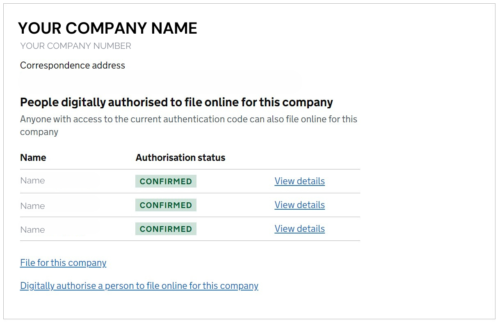
Once you have access, you will be able to see everyone who may also have permission to submit a verification statement for your company online. Below you will see the “Submit for this company” option that you can click to get started.
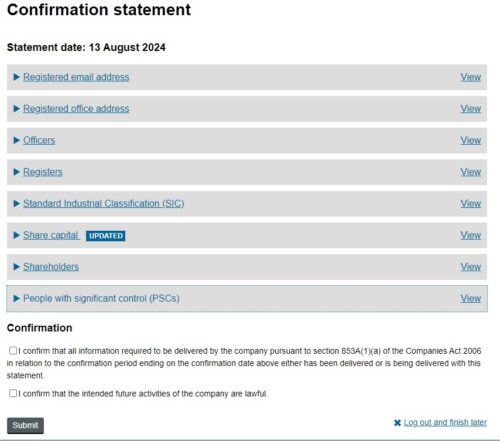
When you submit your verification statement, you will notice that the page is divided into separate sections. You should go through each of these sections to ensure they are correct. If this is the case, you can simply use the bottom two checkboxes to confirm and then click “Submit.”
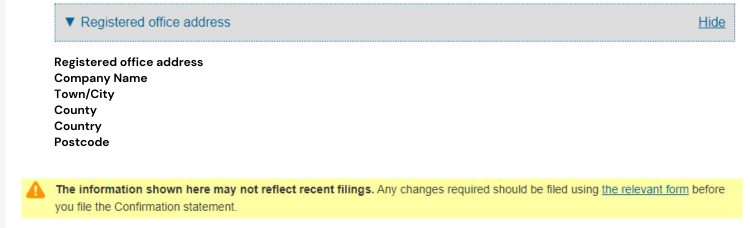
However, if any information is inaccurate and requires corrections, you may need to complete the relevant Companies House form, a link for which is provided in each section.
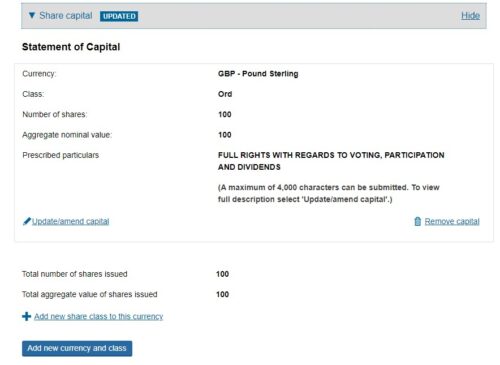
Certain sections may allow you to make changes directly without having to fill out a separate form. However, this is clearly indicated by blue icons.
Once you have thoroughly reviewed each section and are ready to submit your verification statement, you can click submit and everything is done! You will receive an email confirmation indicating that your confirmation statement has been submitted.
When is my confirmation statement due?
The due date of your confirmation statement is another deadline that you must adhere to as part of your corporate compliance. Unfortunately, it is not the same deadline as your corporate tax return, your corporation tax payment or even your annual accounts; However, you can also submit them all on the same day if you wish.
The due date for your confirmation statement is 14 days after your 12-month “review period.” A review period can begin on either the date of your company’s incorporation or the date of your last filed verification statement. For example, you formed a new limited liability company on May 1, 2023. Your review period begins on this day and ends on April 30, 2024. You then have until May 14, 2024 to submit your confirmation statement. Let’s say you registered on May 1, 2023, but submitted your first confirmation statement on September 1, 2023. This would mean your updated review period begins September 1, 2023 and ends August 31, 2024. Your next confirmation statement would be due no later than September 14, 2024.
You must submit a confirmation statement at least once a year. However, you may also submit or update your confirmation statement as often as you wish.
What happens if I submit late?
If you missed the deadline to file your confirmation statement, there is no need to worry. You will not receive any automatic fines or penalties, but you will receive an automatic warning from Companies House that you have not made your confirmation statement. This letter should not be ignored and serves as a reminder that you need to complete your confirmation statement as soon as possible! Ignoring this warning could have serious consequences.
What happens if I don’t submit a confirmation statement?
Failure to file a verification statement is a criminal offense. If you do not file a confirmation statement, the company’s directors and other officers may face legal action from Companies House, which may include a fine. In the most serious cases, directors and officers of the company can be prosecuted.
Additionally, Companies House considers that the failure to file a confirmation statement is due to the company no longer trading. This will result in them initiating legal proceedings to have them compulsorily removed from the register. If this happens, it means your business no longer exists and all assets become the property of the Crown.
Finally, another possible consequence of failing to file a confirmation statement is that directors may be banned from acting as directors of a limited company for up to 15 years for failing to comply with their legal obligations. This is also known as director disqualification and prevents you from setting up new limited companies during the disqualification period.
How much does it cost to file a confirmation statement?
The annual fee for filing a confirmation statement with Companies House is £34 (previously £13 from 1 May 2024) if you file online, or £62 (previously £40, also from 1 May 2024) , if you choose to submit via a paper form.
The annual fee covers your entire payment period, which is not the same as your verification period explained above. Your payment period is 12 months from the date your company was founded and the dates cannot be changed.
If you pay an annual fee, you may file a verification statement as many times as you like during the year, but you will only be charged once per payment period.
Do I still have to submit a confirmation statement if my company is inactive?
Every company is required to file a confirmation statement with Companies House every year, even if your company is inactive. Otherwise, trading companies may suffer the consequences mentioned above. So if you receive a warning letter from Companies House, you shouldn’t ignore it just because your company isn’t actively trading.
Get help filing your confirmation statement
As part of our company secretarial service, we can help you file your bank statement even if your company is not a commercial company. If you are struggling to meet your annual compliance obligations, you can rely on our thorough and diligent team of accountants to ensure your company data is up to date and any changes to your company information are reported. Running a business is challenging, especially if you’re doing it all yourself, but when it comes to everything you need to comply with your business regulations, we can help you from your annual accounts to your corporation tax return for HMRC. Contact us to receive a quote for a tailored package of business support services.

